Think of job costing as giving each project its own mini-financial statement. Instead of lumping all your income and expenses into one big bucket, this accounting method tracks the revenues and costs for each individual "job" you take on.
It’s the difference between knowing your company made a profit last year and knowing exactly which custom home build or marketing campaign was a big winner—and which one quietly lost you money.
Why Job Costing Matters for Your Business
Let's say you run a custom cabinetry shop. If you only look at your overall profit and loss statement at the end of the year, you have no real way of knowing if the Miller kitchen remodel was more profitable than the Jones library build-out. You see the totals, but the story behind the numbers is missing.
That’s the exact problem job costing solves. It gets you out of the weeds of high-level, averaged-out numbers and gives you laser-focused clarity on a project-by-project basis.
Instead of spreading costs across everything you do, job costing lets you tie every dollar of expense directly to the job that created it. This makes it an absolute necessity for any business that delivers unique products or services, like:
- Construction companies building a custom deck or an entire office building.
- Professional service firms—think marketing agencies, law offices, or IT consultants—that manage distinct client projects.
- Custom manufacturers crafting a one-of-a-kind piece of furniture or a specialized machine part.
The Core Components of Job Costing
At its core, job costing is all about meticulously tracking three main types of costs for every single project. Getting a handle on these is the first step. These costs are the building blocks for calculating the total expense of a job, which is fundamental to your understanding of the cost of goods sold for that specific piece of work.
By isolating costs at the project level, businesses can pinpoint which activities are most profitable, identify inefficiencies, and create more accurate quotes for future work, turning accounting data into a strategic asset.
This isn’t some newfangled idea; it’s a concept that’s been around since the industrial revolution. What's changed is how modern tools have supercharged its power. In fact, a recent study found that 68% of small professional service firms using job costing reported a 25% improvement in pricing accuracy. That small change boosted their average profit margins from a respectable 8% to a much healthier 12%.
You can learn more about how to calculate job costing accurately to get similar results. This level of detail is what empowers you to make smarter decisions, ensuring every project is pulling its weight and contributing to your bottom line.
The Three Core Components of Job Costing
To get a true picture of a job's profitability, you need to track three distinct types of costs. Think of it like a three-legged stool—if one leg is off, the whole thing wobbles. Getting this right is the foundation of solid job costing.
This simple diagram shows how these three pieces—direct materials, direct labor, and overhead—all come together.
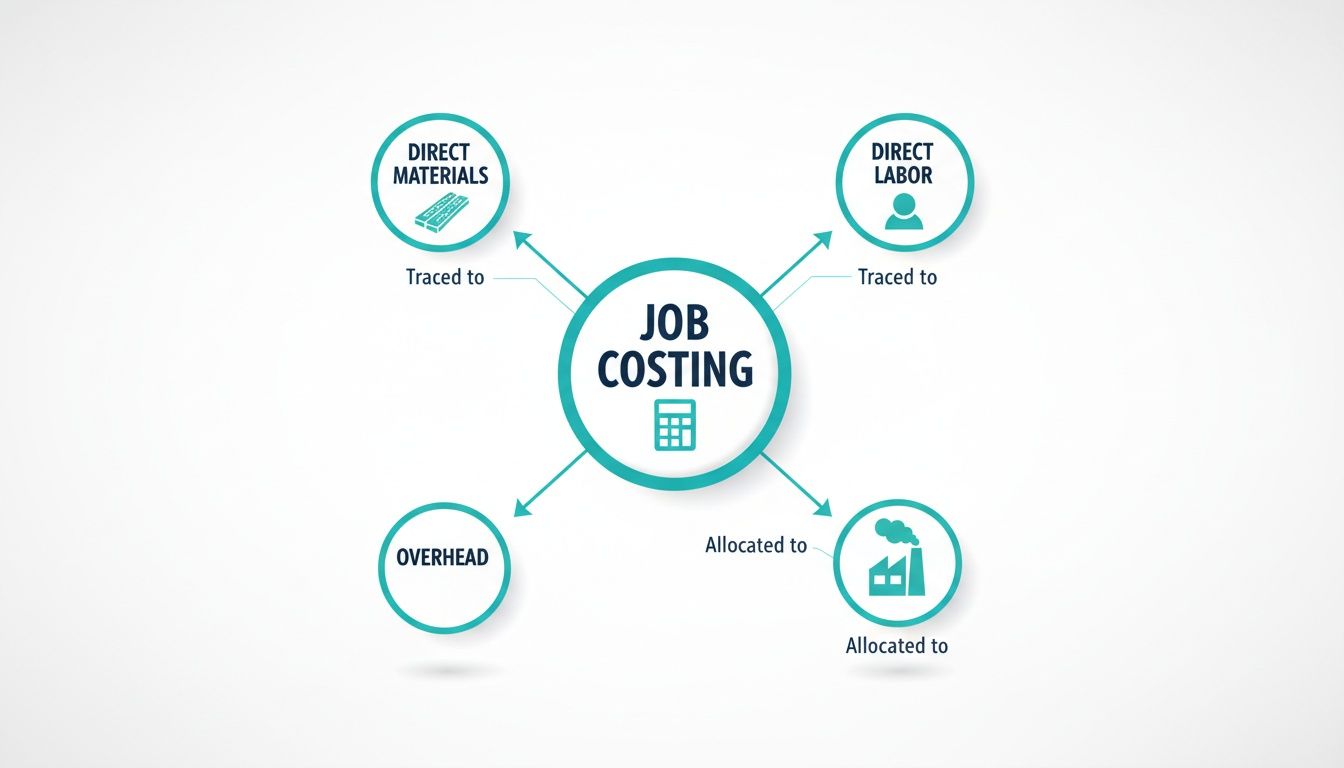
Each one tells a different part of the story, and only by combining them do you see the full financial narrative of a project.
1. Direct Materials
Direct materials are the most obvious costs. These are the physical, tangible items you buy and use specifically for one project. They can be easily pointed to and say, "That went into that job."
For a custom cabinet maker, this is pretty straightforward. The direct materials would be:
- The specific lumber chosen, like maple or oak.
- Hardware, including all the hinges, knobs, and drawer pulls.
- Finishes like the stain, paint, and sealant.
Every one of these items gets assigned directly to a client's project, making sure you don't accidentally spread the cost of one job across another. Setting this up correctly in your books is critical, and a well-structured chart of accounts is the place to start.
2. Direct Labor
Next up is direct labor. This isn't just your payroll; it’s the wages and benefits you pay employees for the specific time they spend working on a particular job.
Imagine a marketing agency creating a campaign. Their direct labor costs are the hours clocked by the team members doing the hands-on work:
- The graphic designer building the ad creative.
- The copywriter scripting the social media updates.
- The project manager who is in client meetings and coordinating the team.
This is where time tracking becomes non-negotiable. If you're not accurately tracking hours against projects, you're essentially guessing what your biggest expense is, which is a recipe for underbidding future proposals.
3. Manufacturing Overhead
Here’s where things get a bit tricky. Overhead covers all the essential business expenses that can't be pinned to a single job. It’s the cost of keeping the lights on—things like your workshop rent, utility bills, or the salary of your office manager.
So, how do you assign a sliver of your monthly rent to one small project? You do it through allocation, using what's called a predetermined overhead rate.
The Goal of Overhead Allocation: To assign a fair and proportional share of indirect costs to each job. This ensures that every project's total cost reflects its true use of the company's resources, not just the obvious materials and labor.
It works like this: First, you estimate your total overhead costs for a set period, say $100,000 for the year. Then, you pick an "allocation base," which is a metric that scales with your work, like direct labor hours.
Let's say you forecast your team will work 10,000 direct labor hours this year. Your overhead rate becomes $10 per direct labor hour ($100,000 ÷ 10,000 hours).
Now, if a specific project took 50 direct labor hours to complete, you would allocate $500 in overhead (50 hours × $10/hour) to that job's total cost. This systematic method makes sure every project carries its fair share of the background expenses, giving you a far more accurate view of its real profitability.
See Job Costing in Action with Industry Examples
Theory is one thing, but seeing how job costing works in the real world is what really makes the concept stick. Let's step away from the textbook definitions and look at how different businesses use this powerful method to get the clarity they need to succeed.
No matter the industry, the basic idea is the same. You’re always trying to solve for this:
Direct Materials + Direct Labor + Allocated Overhead = Total Job Cost
By applying this simple formula to different scenarios, you’ll see just how flexible and essential job costing is, whether you're building a house, running a marketing campaign, or crafting a custom piece of furniture.

The Construction Firm Building a Commercial Space
Construction is the classic example of job costing in its element. Think about a general contractor hired for a $100,000 retail store renovation—a project with a thousand moving parts and tight margins.
To protect their profit, the contractor has to track every single penny tied specifically to this renovation. This includes:
- Direct Materials: The lumber, drywall, flooring, and light fixtures.
- Direct Labor: All wages for the on-site crew, from the carpenters to the project manager.
- Overhead: A fair share of the company's background costs, like office rent, admin salaries, and equipment depreciation.
In construction, getting this right is everything. An Associated General Contractors of America survey found that firms using job costing cut their budget overruns by an average of 22%.
Imagine that retail renovation has a total cost of $75,000, broken down into $28,000 for materials, $32,000 for labor, and $15,000 in overhead. The detailed report might reveal that unexpected subcontractor fees caused a 9% dip in the expected profit. That’s a critical insight that helps the firm create much smarter bids next time. You can learn more about these job costing insights for construction from industry experts.
The Marketing Agency Managing a Client Campaign
Job costing isn't just for businesses that build physical things. Service-based companies, like a digital marketing agency, live and die by their ability to accurately cost their projects. For them, the most important direct cost isn't materials—it's time.
Let's say an agency signs a client for a three-month, $15,000 social media campaign. The project's profitability completely depends on tracking the hours their team puts in.
For service businesses, time is the inventory. Without accurate job costing, you're essentially giving away your most valuable asset without knowing its true cost, making it impossible to price your services for sustainable growth.
The agency’s job cost sheet would track:
- Direct Labor: Hours logged by the copywriter, graphic designer, and account manager.
- Direct Materials (or Costs): Ad spend on social platforms and any licenses for stock photos.
- Overhead: A portion of their office lease, software subscriptions (like Adobe Creative Cloud), and utilities.
By tracking all this, the agency can see if the $15,000 fee actually covers their costs and leaves a healthy profit. If a campaign ends up eating way more hours than planned, that data is gold. It gives them the leverage to renegotiate the client's contract or adjust quotes for new prospects. As we cover in our guide to time tracking for professional services, this process is the engine of profitability.
The Custom Furniture Maker Crafting a Table
Finally, let's look at a custom manufacturer, like a woodworker building a one-of-a-kind dining table. This is a perfect mix of material and labor costs, where every piece of wood and every minute of sanding has to be accounted for.
The job cost for this single table would be calculated by adding up:
- Direct Materials: The precise cost of the walnut slabs, epoxy resin, and finishing oil.
- Direct Labor: The artisan's time spent designing, cutting, sanding, and finishing the piece.
- Overhead: A percentage of the workshop's rent, electricity, and the wear-and-tear (depreciation) on tools like saws and sanders.
Without this detailed breakdown, the furniture maker is just guessing what to charge. But with job costing, they can confidently set a price that covers every expense and ensures they earn a fair profit for their incredible skill and hard work.
Using Job Cost Reports to Drive Business Growth
Tracking your costs is a great start, but the real magic happens when you know how to read the story the numbers are telling you. This is where you turn raw data into smart business decisions. If you skip this step, you're just collecting numbers for the sake of it, not using them to get ahead.

The main tool for this is the Job Cost Sheet—what you'll often see called a Job Profitability Report in systems like QuickBooks. Think of it as a financial report card for each project. It lays out every single dollar you spent on materials, labor, and overhead, and stacks it up right next to the revenue that job brought in.
But just looking at the final profit number doesn't give you the full picture. To really steer your business toward growth, you need to dig into the specific Key Performance Indicators (KPIs) that reveal what’s really going on.
Key Metrics to Monitor for Profitability
Getting granular with your metrics helps you spot patterns, catch problems before they spiral out of control, and—most importantly—price your next job with confidence. These are the financial vital signs of your projects.
Here are two of the most powerful KPIs you can pull from your job cost reports:
- Gross Profit Margin Per Job: This is the percentage of revenue you have left after paying for all the direct costs of the job. You calculate it as (Revenue – Total Job Cost) / Revenue. A high margin is a great sign of a healthy project. A low or negative one? That’s a massive red flag telling you to figure out what went wrong, and fast.
- Budget vs. Actual Costs: This one is simple but incredibly revealing. It’s a direct comparison between what you thought the job would cost and what it actually cost. If you’re constantly seeing actual costs creep over budget in one area—say, labor hours or a specific material—you've just found a weak spot in your estimating or your operations.
By analyzing these reports, you move beyond asking "Did we make money?" to answering "Where and why did we make or lose money?" This insight is the engine for continuous improvement and sustainable growth.
Turning Data into Strategic Action
These reports aren't just about looking in the rearview mirror; they're your roadmap for the future.
Let’s say your Budget vs. Actual reports show labor costs are consistently running 15% higher than you estimated on your renovation projects. That's not a failure—it's a clear signal for action. You can now adjust your quoting formula, look into your crew's efficiency, or get serious about better time tracking.
Likewise, once you know which types of jobs consistently bring in the highest gross profit margins, you can focus your sales and marketing efforts on landing more of that work. It’s about working smarter, not just harder.
The advantage this gives you is huge. One analysis of 50,000 companies found that businesses using job costing had 28% higher net profits than those who didn't, largely because their pricing was 15% more accurate. You can see the full breakdown in this QuickBooks report on job costing benefits.
This data-driven approach turns your accounting from a chore into one of your most powerful strategic tools. This detailed reporting is also essential for creating accurate company-wide financials. To see how this all fits together, check out our guide to better understand profit and loss statements and see how job-level data rolls up into the bigger picture.
How to Implement Job Costing in Your Business
Getting started with job costing can feel like a daunting task, but with today's accounting software, it's far more accessible than it used to be. The real secret is to approach it with a solid plan and establish good habits from the get-go.
This isn't about creating more paperwork. The goal is to build a reliable system that delivers the financial clarity you need to make smarter decisions and actually grow your business. Breaking it down into manageable steps is the best way to get there.
Setting Up Your System for Success
Before you can start tracking costs, you have to lay the groundwork in your accounting software. If you're using a platform like QuickBooks Online, this means flipping a few switches to prepare the system for detailed data collection.
-
Activate Project Tracking: First things first, you need to turn on the projects feature. This is what lets you assign every single dollar of income and every single expense to a specific job. Think of it as creating a mini-P&L for each project.
-
Create Service Items: You'll want to create an "item" for every type of direct cost you have. This could be anything from framing lumber to a senior developer's hourly rate. Setting these up makes it incredibly easy to add costs to an invoice or bill and have them automatically flow to the correct job.
-
Integrate Time Tracking: If labor is a significant part of your costs—and for most businesses, it is—an integrated time-tracking app is non-negotiable. This is the only way to ensure every hour an employee works on a project gets logged and billed correctly. It’s the single best way to plug one of the most common profit leaks.
Best Practices for Consistent and Accurate Tracking
With your system configured, the focus shifts from setup to discipline. Bad data in means bad data out, and inconsistent data entry will completely undermine your efforts, leaving you with reports you can't trust.
The accuracy of your job costing reports is a direct reflection of the quality of your data entry. A commitment to consistency is non-negotiable for anyone serious about understanding project profitability.
To keep your data clean and your reports reliable, build these habits into your workflow:
- Be Consistent: Make sure everyone on your team knows exactly how to code expenses and log their time to the right project. A little training upfront saves a ton of headaches later.
- Review Regularly: Don't wait until the job is over to see how you did. Check your Job Profitability reports at least weekly. This is how you catch cost overruns before they sink your budget.
- Reconcile Often: Treat your job cost data like you treat your bank account. Regularly ensure it matches up with your main financial statements to catch any discrepancies early.
For businesses in the services sector, choosing the right software is a make-or-break decision. You can explore some of the best platforms out there in our guide to the top professional services accounting software.
Answering Your Top Job Costing Questions
Getting started with job costing always brings up a few questions. That's a good thing—it means you're digging into the details and thinking about how to make it work for your specific business.
Let's walk through some of the most common questions we hear from business owners as they put these systems into practice.
How Often Should I Review My Job Cost Reports?
For active projects, you should be looking at your reports weekly. No exceptions. This is your early warning system. It's how you catch a small budget overrun before it spirals into a major loss. Think of it as a quick financial health check for each job.
Beyond the weekly check-ins, a monthly review of all your job reports is crucial. This is where you zoom out to see the bigger picture. You'll start to spot trends—which types of projects are your real money-makers, where you consistently underestimate costs, and how accurate your initial bids really are.
Can Job Costing Be Used for Service Businesses?
Yes, and it's absolutely critical. People often associate job costing with construction or manufacturing, but it’s just as powerful for marketing agencies, law firms, IT consultants, and other service-based companies. The only thing that changes is what you're tracking.
In a service business, your team's time is your inventory. The hours they spend working directly for a client are your biggest direct cost, and you have to track them.
You might not have a lot of direct materials, but every billable hour is a cost that needs to be assigned to a specific client or project. Without that data, you're just guessing at profitability and potentially pricing your services too low to be sustainable.
What Is the Biggest Mistake to Avoid with Job Costing?
The most damaging and frequent mistake we see is the failure to track all direct labor costs accurately. It's so easy to overlook. An owner jumps in to help on a project for a few hours, or an admin assistant spends half a day preparing client materials, and nobody logs that time to the job.
When that happens, the job looks more profitable on paper than it actually was. This creates a dangerous feedback loop. You use that faulty "profit" data to bid on your next project, underpricing it from the start and slowly eroding your margins over time. The fix is simple but non-negotiable: everyone who touches a client project must track their time.
Ready to stop guessing and start knowing the true profitability of every job? The team at Bugaboo Bookkeeping can set up, manage, and maintain a powerful job costing system for your business. Schedule your free consultation today!