

Substantive auditing procedures are where the rubber meets the road in a financial audit. These are the specific, hands-on tests an auditor performs to verify the actual numbers sitting on your company’s financial statements. It’s how they gather concrete evidence to confirm that your reported assets, liabilities, and equity are accurate and not hiding any major errors.
In short, these procedures form the very heart of an audit.
What Substantive Auditing Procedures Mean for Your Business
Think of it like a thorough health checkup for your company’s finances. An auditor’s primary job is to hunt for material misstatements—errors big enough to potentially mislead a lender, investor, or anyone else relying on your financial reports. They aren’t there to nitpick every tiny typo; they’re focused on confirming the overall truth and fairness of your financial story.
It’s a lot like a home inspector checking a house’s foundation, wiring, and plumbing before a sale. An auditor uses these procedures to dig into your transactions and account balances. They don’t just take your word for it; they need to see the proof for themselves.
The Goal Beyond Compliance
Sure, audits are often a requirement—maybe a lender demands one or regulations call for it—but their real value is the confidence they create. A clean audit opinion is a powerful signal to the world that your financial statements can be trusted. This process isn’t something to fear; it’s a tool for hitting your most important business goals.
An audit built on solid substantive procedures can help your business:
- Improve Financial Clarity: You’ll walk away with a much sharper understanding of your company’s true financial position and performance.
- Boost Investor Confidence: Nothing attracts and keeps investors like professionally verified financial information.
- Secure Loans More Easily: Lenders are far more comfortable extending credit when they know your numbers have been independently validated.
Two Core Methods of Verification
Auditors typically use two main approaches to get the evidence they need. The first is getting into the nitty-gritty, digging into individual transactions, like physically inspecting a major sales invoice and matching it to a shipping document. The second is taking a high-level view, analyzing trends and relationships in your financial data to see if anything looks out of place.
The core purpose of an audit isn’t to catch you making mistakes. It’s to provide “reasonable assurance” that your financial statements present a fair and accurate picture, giving stakeholders the confidence to trust your numbers.
The entire audit process hinges on one thing: the quality of your bookkeeping. If your records are a mess, the audit becomes a painful, expensive scramble to find documents. But if your books are clean and organized year-round, it’s just a smooth, predictable review.
Understanding the fundamentals of good record-keeping is the absolute first step to being perpetually audit-ready. You can learn more about these foundational practices by reviewing the bookkeeping basics for small business owners. Being prepared isn’t just about passing an audit; it’s a strategic advantage that makes your business stronger from the inside out.
The Two Pillars of Substantive Testing
When an auditor sets out to verify your financial statements, they don’t just use one approach. Think of it like a doctor giving a patient a check-up. They’ll take your vitals—blood pressure, temperature—for a quick overview, but they’ll also order specific lab tests to get a detailed diagnosis. In auditing, we have a similar two-pronged strategy.
These two core methods are Tests of Details and Substantive Analytical Procedures. They work hand-in-hand to build a complete, accurate picture of your company’s financial health. One method looks at the individual brushstrokes, while the other steps back to see the entire painting.
Tests of Details: The Detective Work
This is the classic audit work that most people imagine. It’s the detailed, granular digging into individual transactions, account balances, and disclosures. Like a detective meticulously following a lead, the auditor selects a sample of items and traces them back to the source to confirm they’re legitimate.
For instance, if an auditor is looking at a major equipment purchase on your books, they might:
- Pull the original supplier invoice to confirm the exact cost.
- Match the payment to a specific withdrawal on the bank statement.
- Go and physically inspect the equipment to make sure it actually exists.
- Review the purchase contract to understand all the terms and conditions.
This kind of testing provides direct, powerful evidence about specific items. It’s incredibly effective for proving that assets exist, are valued correctly, and are actually owned by the company.
The ultimate goal of substantive auditing procedures is to build confidence in your financial story. This infographic visualizes how a financial health checkup leads to clarity for decision-making, confidence for stakeholders, and easier access to loans.
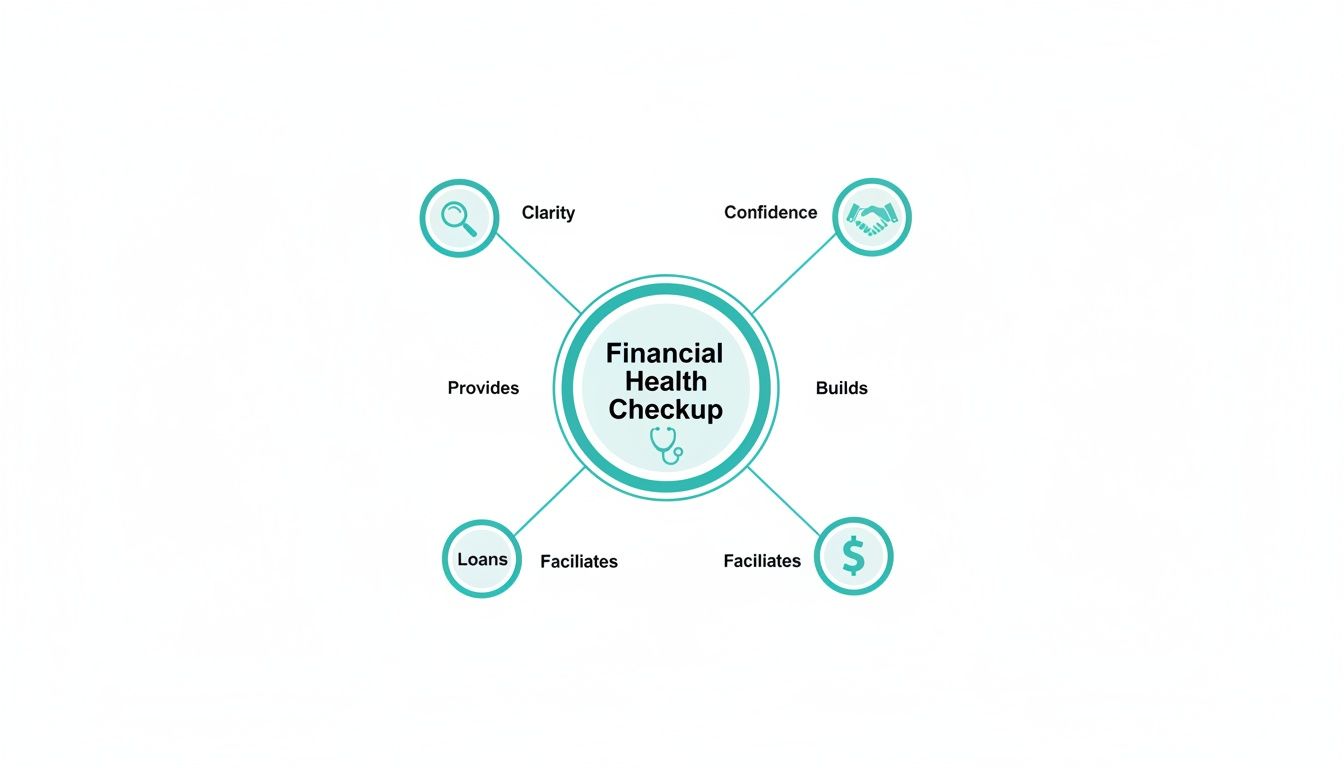
Every one of these outcomes—clarity, confidence, and access to capital—is a direct result of having financials that have been thoroughly vetted through these detailed and analytical tests.
Substantive Analytical Procedures: The Big-Picture Analysis
While tests of details zoom in, substantive analytical procedures zoom out. This approach involves looking at your financial information through the lens of relationships and trends, both within your numbers and against outside data. Instead of checking one invoice, an auditor looks for patterns, fluctuations, or anomalies that just don’t add up.
This isn’t a new concept; it’s been a cornerstone of auditing for decades. In fact, the Public Company Accounting Oversight Board (PCAOB) has been refining these standards since 1989 and continues to update them for modern data analytics. When done right, these procedures can reduce the risk of major errors in your income statement by up to 30%. You can get a great overview of their evolution from Kreston Global’s analysis on substantive analytical procedures.
So what does this look like in practice? Imagine an auditor notices your company’s revenue shot up by 50% this year, but all your competitors only grew by 5%. That’s a red flag. It doesn’t mean something is wrong, but it absolutely signals that a closer look with tests of details is needed. The relationships between accounts, all laid out in your chart of accounts, are the foundation for this kind of high-level review.
Tests Of Details Vs Substantive Analytical Procedures
To put it all together, here’s a simple breakdown of how these two essential procedures compare and complement each other.
| Aspect | Tests of Details | Substantive Analytical Procedures |
|---|---|---|
| Purpose | Verify the accuracy and validity of individual transactions, balances, or disclosures. | Identify unusual fluctuations, trends, or relationships that might indicate misstatements. |
| Approach | “Bottom-up.” Starts with individual items and confirms them against source documents. | “Top-down.” Starts with high-level data and looks for inconsistencies or anomalies. |
| Evidence | Provides direct, conclusive evidence about a specific item. | Provides circumstantial or corroborating evidence; often points to areas needing more testing. |
| Example | Examining an invoice for a specific sale. | Comparing this year’s gross margin percentage to last year’s and industry averages. |
| Best For | Confirming existence, ownership, and valuation of balance sheet items (e.g., cash, inventory). | Auditing high-volume, predictable income statement accounts (e.g., payroll, revenue). |
By combining the nitty-gritty detective work of detail testing with the eagle-eye view of analytical procedures, auditors build a robust and comprehensive understanding of your business’s financial reality.
How Auditors Test Your Key Business Accounts

Understanding the theory is one thing, but seeing how auditors actually poke and prod your books is where it all clicks. They don’t just pull numbers out of a hat; they have a specific playbook for the accounts you manage every day. This is exactly where organized, clean bookkeeping can make your audit a smooth ride instead of a bumpy one.
Let’s pull back the curtain and see how auditors apply both detailed transaction testing and big-picture analysis to your most critical accounts.
Checking the Cash in Your Bank
Cash is usually the first stop. It’s the lifeblood of your business, and unfortunately, it’s also a magnet for potential fraud. The auditor’s goal is straightforward: prove that the cash you say you have actually exists and belongs to your company.
The most common substantive auditing procedures for cash include:
- Bank Confirmations: This is a classic test of details. The auditor sends a formal request straight to your bank, asking them to independently confirm your balances on the last day of the fiscal year. It’s powerful, third-party proof that cuts right to the chase.
- Testing Bank Reconciliations: Your auditor will want to see your month-end bank reconciliations. They’ll trace things like outstanding checks and deposits in transit to the very next month’s bank statement to make sure everything cleared as it should have.
- Cutoff Analysis: This is all about timing. Auditors zero in on transactions recorded a few days before and after your year-end date to ensure cash receipts and payments landed in the correct accounting period.
Validating Accounts Receivable
Your accounts receivable (A/R) is the pile of money your customers owe you. Here, an auditor’s job is to verify that these IOUs are real, valued correctly (meaning, you can realistically collect them), and are rightfully yours. Getting A/R and A/P straight is a bookkeeping fundamental—you can dive deeper into the difference in our guide to accounts payable vs accounts receivable.
Common tests for A/R include:
- A/R Confirmations: Just like with the bank, the auditor will send letters directly to a sample of your customers, asking them to confirm the exact amount they owe you. This is one of the most reliable tests an auditor can perform.
- Subsequent Cash Receipts Testing: What if a customer doesn’t send the confirmation letter back? The auditor has a backup plan. They’ll look for payments received from that customer after the year-end, which proves the debt existed and was eventually paid.
- Aging Analysis: This is more of an analytical procedure. The auditor reviews your A/R aging report to spot old, dusty balances that might be uncollectible. They’ll then assess your “allowance for doubtful accounts” to make sure it’s a reasonable estimate and that your A/R isn’t over-inflated.
An auditor’s approach is to use a mix of procedures. For receivables, they might confirm 80% of the balance through direct letters (details) and analyze the collection trends for the other 20% (analytical) to get a complete picture.
Verifying Physical Inventory
If you sell products, your inventory is probably one of the biggest numbers on your balance sheet. The goal here is simple: prove the inventory physically exists, is valued at the right cost, and is actually in a condition to be sold. A mistake here can have a massive ripple effect on your financials.
Key inventory tests are:
- Observing the Physical Count: This is the big one. The auditor will physically show up for your year-end inventory count. They’ll watch your team’s process, do their own spot-checks (called test counts), and confirm the stock is really there.
- Costing and Valuation Tests: The auditor will pick a sample of items from your inventory list and trace them back to the original supplier invoices to verify what you paid for them. They’re also on the lookout for old, obsolete, or slow-moving items that might need to be written down in value.
- Inventory Turnover Analysis: This is a smart analytical test. An auditor will calculate how quickly you’re selling and replacing your inventory and compare that ratio to previous years and industry averages. A sudden slowdown could be a red flag for unsellable stock.
Examining Payroll and Revenue
Payroll and revenue are high-volume areas where auditors often lean on analytical procedures first, then dive into the details where needed. They’re focused on accuracy, making sure everything was recorded properly, and confirming the transactions are legitimate.
Recent audit standards, like the AICPA’s SAS 145, push auditors to be smarter and more targeted in their risk assessment. Instead of a shotgun approach, they focus on what could actually go wrong with your most important accounts. And the data backs this up—blending analytics with detail tests can uncover 25-40% more issues than just using one method alone. Better yet, modern digital tools can slash manual errors by 50% and boost audit efficiency by 35%, a huge win for small businesses.
So for payroll, an auditor might start by comparing this year’s total payroll expense to last year’s, factoring in any changes in your team’s size. If that looks reasonable, they might just test the details for a few new hires, checking their pay rates against their offer letters.
It’s a similar story for revenue. They might first analyze monthly sales trends to spot any weird spikes or dips (analytical). Then, to get comfortable, they’ll select a handful of large sales and trace them all the way back to shipping documents and customer invoices to confirm they were real, earned sales (details). This one-two punch gives them strong assurance that your key accounts are in good shape.
Why Organized Documentation Is Your Best Defense in an Audit

When an auditor starts asking for documents, it can feel like a sudden, overwhelming demand for every piece of paper you’ve ever touched. But this isn’t just busywork. It’s all about gathering audit evidence—the tangible proof they need to back up every conclusion they draw about your finances.
Think of it like this: your financial statements are making a series of claims about your business. The auditor’s job is to play detective and verify those claims with concrete, reliable proof. A verbal promise of a sale is just hearsay. A signed contract, a matching invoice, and a shipping receipt? That tells a complete, trustworthy story.
The Two Qualities of Strong Audit Evidence
Auditors don’t just want a mountain of paperwork; they’re looking for the right kind of paperwork. High-quality audit evidence always has two key characteristics. Understanding them makes it clear why they ask for specific documents.
The evidence must be:
- Sufficient: This is all about the quantity of evidence. Did the auditor collect enough proof to support their conclusion? For a small expense, one receipt might be fine. For a major new asset, they’ll likely need the purchase agreement, the bank withdrawal, and maybe even a photo to feel confident.
- Appropriate: This refers to the quality of the evidence. It has to be both relevant (it directly relates to the financial claim being tested) and reliable (it comes from a trustworthy source).
For instance, an original bank statement sent directly to the auditor from the bank is far more reliable than a screenshot you email them. A contract signed by both parties is infinitely stronger than an internal memo merely discussing the deal.
Audit evidence is the absolute bedrock of a good audit. Auditors aren’t just collecting documents; they’re constantly evaluating them for relevance and reliability. A modest audit can easily involve sifting through over 1,000 documents, which makes organization non-negotiable for both the business and the auditor.
Building Your Fortress of Evidence Every Day
The secret to a smooth, stress-free audit isn’t a frantic, last-minute scramble to find a year’s worth of paperwork. The real key is building your foundation of evidence systematically, all year long, through clean and consistent bookkeeping.
When your bookkeeper meticulously codes transactions every day, they’re creating a real-time audit trail. When they reconcile your bank accounts each month, they’re generating perfect, third-party proof that your cash balance is accurate. This transforms audit prep from a massive, painful project into a simple review of records that are already in great shape.
A solid system for managing your documents is a must. If you’re looking for a good place to start, our guide on how to organize business receipts offers a practical framework for creating that clean paper trail.
Ultimately, every single substantive auditing procedure is a request for evidence. By staying organized, you’re not just preparing for a potential audit—you’re building a more transparent, resilient, and trustworthy business from the inside out. It turns the audit from something to be feared into a valuable confirmation of all the great work you’re already doing.
Of course. Here is the rewritten section with a more natural, human-written tone.
Understanding Materiality and Audit Sampling
To really get a handle on how substantive procedures play out in an actual audit, you need to understand two core concepts that drive an auditor’s every move: materiality and audit sampling. These aren’t just technical terms; they are what make a financial audit practical and focused.
For business owners, this is good news. It means the audit isn’t about hunting down every last penny. Instead, these principles help auditors zero in on what actually matters for the integrity of your financial statements.
Materiality: Your Auditor’s Significance Threshold
Think of materiality as the auditor’s line in the sand. It’s the threshold they establish to decide if an error or a missing piece of information is big enough to actually sway the judgment of someone reading your financial reports—like a potential investor or a bank. If knowing about a mistake would change their decision, it’s considered “material.”
This isn’t a one-size-fits-all number. It’s a professional judgment call that depends on the size and nature of your business. For a company with millions in revenue, a $100 invoicing error is a rounding error—completely immaterial. But a $100,000 overstatement of revenue? That’s almost certainly material and would demand a much closer look.
Materiality is what lets an auditor focus on the big rocks instead of the pebbles. It ensures their substantive procedures are aimed at high-risk areas where a major error could realistically be hiding, making the whole process efficient and effective.
Once you grasp this, it’s easier to understand why an auditor might spend a week poring over your major sales contracts but only give a passing glance to the petty cash box. It’s all about putting effort where it counts.
Audit Sampling: Tasting the Soup to Judge the Pot
Let’s be realistic: it would be wildly impractical—not to mention incredibly expensive—for an auditor to examine every single transaction your business conducted over an entire year. This is where audit sampling saves the day.
It’s the simple, powerful technique of selecting a small but representative portion of items to test, then drawing a conclusion about the whole group.
The classic analogy holds true: a chef doesn’t need to drink the entire pot of soup to know if it’s seasoned correctly. A single spoonful tells them everything they need to know. In the same way, an auditor can test a sample of, say, 50 accounts receivable invoices to get comfortable that all 5,000 customer balances are fairly stated.
This risk-based approach is becoming even more vital. The upcoming Global Internal Audit Standards, set to take effect in 2025, are pushing audit plans to be more targeted. In fact, the 2025 IIA Pulse Report for North America found that 47% of internal audit teams now prioritize fraud investigation using substantive tests. For SOX-compliant companies, that number skyrockets to 79%. This intense focus means auditors have to use sampling smartly to dig deep into high-risk areas without getting bogged down.
By combining materiality with sampling, auditors can perform powerful and insightful substantive auditing procedures without bringing your business to a halt. They design tests to get the most assurance with the least disruption, giving everyone confidence in the final numbers.
How Proactive Bookkeeping Keeps You Audit-Ready
For most business owners, the word “audit” brings on a cold sweat. It triggers visions of frantic searches for old receipts, late nights spent poring over spreadsheets, and a general sense of dread about what the auditors might uncover. That reactive, fire-drill approach is exactly what makes an audit so painful.
But it doesn’t have to be that way. The secret to a painless audit isn’t about last-minute cramming. It’s about having your financial house in such good order every single day that an audit becomes a simple, straightforward review. That’s the power of proactive, professional bookkeeping—it turns audit readiness into a daily routine, not a once-a-year crisis.
Turning Daily Tasks into an Audit Defense
Think about it: every single substantive auditing procedure is really just a request for organized proof. When an auditor wants to trace a large equipment purchase back to its invoice or verify a specific sales transaction, they’re testing the integrity of your records. If your books are a mess, they have to dig deeper, which means more questions, more time, and ultimately, more cost for you.
On the other hand, consistent, professional bookkeeping builds your audit defense one brick at a time, every single day.
- Daily Transaction Coding: When every transaction is properly coded as it happens, you build an accurate ledger in real-time. No more end-of-year guesswork.
- Monthly Reconciliations: This is non-negotiable. Reconciling your bank and credit card statements each month provides third-party proof that your cash figures are correct—often the very first thing an auditor checks.
- Clean Financial Reporting: Getting accurate financial statements every month means the year-end numbers are just the sum of 12 well-documented periods. There are no surprises.
This methodical process is the perfect answer to an auditor’s demands. The document request list, often called the “Prepared By Client” (PBC) list, can be overwhelming. Even a modest audit can involve tracking down over 1,000 documents. Without a system, that task alone can grind your business to a halt.
From Scrambling to Smooth Sailing
Picture the two scenarios. In the reactive world, an audit notice sends your team on a scavenger hunt through shoeboxes and disorganized digital folders. But in a proactive world, you simply pull up a neatly organized file with every invoice, contract, and bank statement ready to go.
The core message is simple: the best way to handle an audit is to be ready for one every single day. Consistent bookkeeping turns a potential crisis into a predictable, manageable process.
This isn’t just about surviving an audit; it’s about building a healthier, more transparent business. When your financial data is always reliable, you make smarter decisions, get loans approved faster, and plan for the future with real confidence. That peace of mind is priceless.
Of course, maintaining this level of financial discipline in-house can be a huge burden for a small business. That’s where getting professional support changes the game. If you’re curious about how a dedicated team can keep you audit-ready all year long, you can learn more about the benefits of outsourced bookkeeping for small business and how we prepare our clients for any financial review.
Ultimately, proactive bookkeeping ensures an audit isn’t an interruption. It’s just a confirmation of the solid work you do every day. It’s the difference between being caught off guard and being confidently prepared.
Your Substantive Audit Questions, Answered
Even with a solid grasp of the basics, it’s natural to have questions about what a substantive audit looks like on the ground. Let’s tackle a few of the most common ones we hear from business owners.
How Long Does a Substantive Audit Take?
This is the classic “it depends” answer, but it’s the truth. For a small business with pristine records, the whole process might be wrapped up in a week or two. For a larger company, or one with records that are a bit of a mess, it could easily stretch into a multi-month project.
The biggest variable by far is organization. If an auditor can easily get their hands on what they need, they can fly through their procedures. But if they’re stuck waiting while you spend half a day digging for one specific invoice, everything grinds to a halt.
Why Do Auditors Ask for So Many Documents?
Auditors live by the mantra “trust, but verify.” Their professional reputation and license depend on gathering enough solid evidence to back up their opinion on your financial statements. They can’t just take your word for it.
Think about a single sale. To really prove it happened and was recorded correctly, an auditor might need to see:
- The customer’s signed purchase order.
- The shipping document (like a bill of lading) showing the product left your warehouse.
- Your official sales invoice sent to the customer.
- The deposit hitting your bank account as proof of payment.
Each document is a piece of the puzzle. Together, they form a complete, undeniable trail that confirms the transaction from start to finish. This is exactly why having your paperwork in order isn’t just a nice-to-have; it’s essential for a smooth audit.
“A modest audit—with 20 individual test procedures, 25 samples per test, and just two documents per sample—forces you to juggle over 1,000 documents.”
That number really puts the scale of the documentation into perspective. When you’re prepared, you’re not just saving your own time—you’re helping the auditor work more efficiently, which often translates to a lower final bill.
Can an Audit Find Fraud?
Yes and no. Substantive auditing procedures are designed to catch significant errors in your financials, whether they’re accidental mistakes or intentional fraud. Auditors are trained to be skeptical and look for red flags.
However, a standard financial audit isn’t a forensic investigation. The main goal is to issue an opinion on whether the financial statements are fairly presented, not to hunt for criminals. If an auditor stumbles upon something that looks like fraud, they have a professional duty to report it up the chain to management or the board. But a clever, well-hidden scheme might still go undetected.
An audit doesn’t have to be a nightmare. With smart preparation and clean books, it can be a really valuable process that confirms all your hard work. At Bugaboo Bookkeeping, we keep your business audit-ready 24/7, making sure your records are always organized, accurate, and prepared for any level of review. See how our fixed monthly services can give you that year-round confidence at https://bugaboobookkeeping.com.