
When you're a small business owner in Washington, the question of payroll isn't just about cutting checks. It’s about deciding where your time is best spent. For some, the best "software" is a DIY platform like QuickBooks Online Payroll because it offers control and keeps costs down. For others, the best solution isn't software at all—it's handing the entire headache over to an outsourced expert to gain peace of mind and time back.
There's no single right answer. Your decision boils down to your company's size, the complexity of your payroll, and frankly, what you're willing to learn and manage yourself.
Choosing Your Washington State Payroll Solution

For a Washington-based small business, getting payroll right is a high-stakes game. One wrong move can lead to painful penalties. Let's cut through the noise and compare the two real paths you can take.
The first route is the Do-It-Yourself (DIY) software path. Think of platforms like QuickBooks Online Payroll. You're in the driver's seat, responsible for entering hours, running the numbers, and making sure the tax forms are generated correctly. This approach gives you total control and is often the most affordable option, at least on the surface.
The second path is bringing in a pro with an outsourced payroll service. Here, you delegate the whole process to a firm that lives and breathes payroll. They handle everything from running the numbers and filing taxes to staying on top of every quirky state regulation. The goal is to free up your time and minimize your risk by putting a specialist in charge.
Key Factors in Your Decision
Washington's payroll rules are notoriously tricky. We're not just talking about federal taxes; our state has its own set of programs that create a ton of administrative work. Your choice between DIY and outsourcing really hinges on how comfortable you are managing these moving parts.
- Washington Paid Family and Medical Leave (PFML): You have to calculate, withhold, and remit premiums for both your company and your employees.
- WA Cares Fund: Another line item to track and manage for the state's long-term care insurance program.
- Local Tax Ordinances: If you're in a city like Seattle, you might also have to deal with additional rules like the JumpStart payroll tax.
The core question every Washington business owner needs to ask is simple: Do I want to become an expert in state payroll compliance, or do I want to hire one? Your answer immediately points you in the right direction.
This guide is designed to help you make that call. We'll look at each option through the specific lens of a Washington business, considering your headcount, industry, and day-to-day needs. Getting a handle on Washington State small business taxes is the first, most critical step in choosing a path that lets you focus on growing your business, not just running it.
| Feature Comparison | DIY Payroll Software | Outsourced Payroll Service |
|---|---|---|
| Primary Responsibility | You (the business owner) | The service provider |
| Best For | Very small teams (1-3 employees), simple payroll structures | Businesses with 5+ employees, hourly workers, or complex needs |
| WA Compliance | Requires manual setup and ongoing monitoring | Proactively managed by experts |
| Time Investment | High; requires hours each pay period | Low; minimal time needed from you |
Your Two Main Paths for Payroll
Before we get into a side-by-side feature comparison, let's talk about the big picture. Choosing how to run payroll isn't just about picking a product; it’s about deciding on a core business process. This choice shapes who is ultimately responsible for making sure your team gets paid correctly and on time, every single time.
You can either take the wheel yourself or hand the keys to a specialist. Both are perfectly good options, but they're built for very different types of business owners and their specific needs.
The DIY Approach: Payroll Software
The Do-It-Yourself (DIY) route puts you in direct control. With payroll software like Gusto or QuickBooks Payroll, you get a powerful set of tools, but it's up to you to run the show. You’re the one entering hours, approving the final numbers, and making sure all the tax settings are correct.
This model is all about empowerment. The software does the heavy lifting, but you're the one managing the process. Core features usually include:
- Automated Calculations: The system crunches the numbers for federal and state withholdings, deductions, and net pay.
- Direct Deposit & Payments: Easily pay both employees and contractors electronically, no paper checks needed.
- Employee Self-Service: Your team gets their own online accounts to view pay stubs and W-2s, cutting down on the questions you have to answer.
The big draw here is the low cost and complete transparency. You can see everything as it happens and make changes instantly. The trade-off? The buck stops with you. All the responsibility for compliance, especially with Washington State’s unique rules, falls directly on your shoulders.
The Outsourced Approach: Payroll Services
The other path is to hand the entire process over to an outsourced payroll service. Here, you're not just buying software; you're hiring a dedicated team of payroll experts. This model is built on delegation, reducing your risk, and getting valuable time back in your day.
An outsourced provider truly manages everything for you. They process the payroll runs, file all your federal and state taxes, and stay on top of compliance with things like Paid Family and Medical Leave (PFML) and the WA Cares Fund. All you do is send over the hours and employee details, and they take it from there. This is less of a tool and more of a partnership—one where your provider takes on a huge chunk of the liability. You can dive deeper into the benefits of outsourcing your payroll to see if it’s a good fit.
The critical difference is liability and expertise. With software, you are the payroll expert. With an outsourced service, you are hiring the payroll expert.
Deciding between these two is a fundamental first step. It's surprising how many small businesses haven't yet made the move to a dedicated system. Data for 2024–2025 shows that 51% of U.S. organizations still use spreadsheets, and another 19% use other manual methods for payroll. For a small business, simply adopting a modern system—whether DIY or outsourced—is a huge opportunity to boost efficiency and accuracy. You can find more details about payroll technology adoption on selectsoftwarereviews.com.
So, finding the best payroll software for your small business—or deciding to skip software for a service—really starts here. Do you want to be in the driver’s seat, or do you want a professional co-pilot to handle the entire journey for you?
DIY Software vs. Outsourced Service: A Detailed Comparison
When you're running a small business, deciding how to handle payroll is a major fork in the road. It's not just about picking some software; it’s a strategic choice that directly impacts your time, your budget, and frankly, your legal exposure. Let's break down the real differences between going the DIY route with software and handing the reins over to an outsourced service.
This infographic gives you a great visual starting point for the two main options on the table.
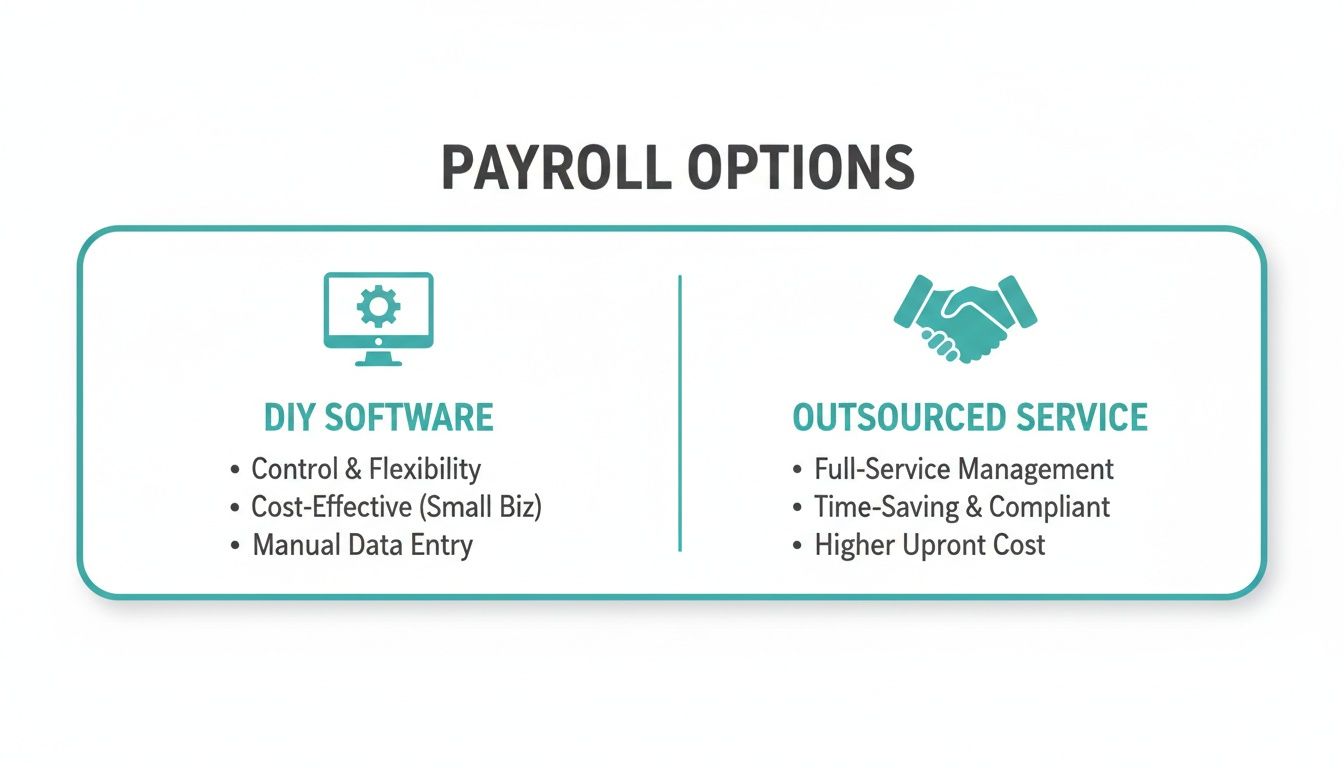
As you can see, it boils down to a classic trade-off: direct, hands-on control with software versus the peace of mind that comes from expert delegation.
Cost Structure Unpacked
The most obvious difference you'll see is how you pay for it. With DIY software like QuickBooks Online Payroll, you’re usually looking at a predictable monthly subscription. It's often a base fee plus a small charge for each employee, which makes budgeting feel straightforward and can seem like the cheaper option on the surface.
Outsourced services, on the other hand, typically work on a comprehensive retainer. That fee is higher, no doubt, but it's because you're getting much more than just software. It bundles the technology with expert management, all your tax filings, and ongoing compliance oversight into one all-inclusive price for a completely hands-off solution.
But the sticker price isn't the whole story. The true cost of DIY software has to include the value of your own time—every minute you spend on data entry, double-checking calculations, or figuring out an error. You can learn more about the often-overlooked hidden costs of DIY bookkeeping and payroll that can quickly add up.
The real comparison isn't just software fees versus service retainers. It's about a predictable monthly cost versus the unpredictable cost of your time and potential compliance errors.
DIY Software vs. Outsourced Service: A Head-to-Head Comparison
To make the choice clearer, here’s a quick-glance summary of the key differences between managing payroll yourself with software and outsourcing it to a professional firm like Bugaboo Bookkeeping.
| Feature | DIY Payroll Software (e.g., QuickBooks Payroll) | Outsourced Payroll Service (e.g., Bugaboo Bookkeeping) |
|---|---|---|
| Cost | Lower monthly fee (base + per employee). | Higher all-inclusive monthly retainer. |
| Time Investment | You spend several hours per month on data entry, processing, and troubleshooting. | You spend minutes approving hours; the service handles the rest. |
| Compliance Risk | 100% on you. Errors in setup or filing are your responsibility. | Liability is shared. The service takes responsibility for accuracy and timeliness. |
| Expertise | You need to be the expert or learn on the fly. | You get dedicated access to payroll and tax compliance experts. |
| Best For | Businesses with simple, salaried payroll and owners who are comfortable with the details. | Businesses with hourly workers, complex pay structures, or owners who want to focus elsewhere. |
Ultimately, the table highlights that while DIY software is a tool, an outsourced service is a partnership. Your choice depends on how much time and risk you're willing to personally manage.
Time Investment: The Owner’s Role
As a business owner, your time is your most valuable asset. This decision directly dictates how much of that precious resource gets sunk into payroll administration every pay period.
With DIY software, you are the payroll administrator. Your to-do list includes:
- Data Entry: Keying in all the hours, commissions, bonuses, and expense reimbursements.
- Process Management: Actually running the payroll, reviewing reports for accuracy, and making sure payments go out.
- Troubleshooting: Hunting down and fixing any errors, like an incorrect withholding or a missed deduction.
This hands-on approach can easily eat up several hours a month, especially if you have hourly employees or pay schedules that change.
Outsourcing completely flips the script. Your role shifts from administrator to approver. Your only job is to send over the raw hours and note any changes for the pay period. The service takes it from there, freeing you up to reinvest those hours into things that actually grow your business—like sales, marketing, and taking care of your customers.
Compliance Liability: Where the Buck Stops
For Washington business owners, this is arguably the most important factor. Payroll mistakes can trigger some seriously steep penalties from both the IRS and the Washington State Employment Security Department. Where the liability for those mistakes falls depends entirely on which path you choose.
With DIY payroll software, all compliance liability rests squarely on your shoulders. The software is just a tool; it automates calculations based on the data and settings you provide. If you misclassify an employee, set up a WA Cares Fund deduction incorrectly, or miss a tax filing deadline, the resulting fines are 100% your problem.
When you partner with an outsourced service, you transfer a huge chunk of that liability. The provider is the expert whose job is to ensure accurate calculations, timely tax filings, and staying on top of constantly changing regulations. If they make a mistake, they are typically on the hook for fixing it and covering any penalties. That shared risk provides a level of peace of mind you just can't put a price on.
Navigating Washington State Payroll Compliance

Running payroll in Washington isn't like anywhere else in the country. Our state’s unique blend of employee benefit programs and local taxes creates a compliance minefield that can easily trip up even the most careful business owner.
Getting these specific details right is non-negotiable. It's a huge factor when you're weighing DIY software against an outsourced payroll service. This goes way beyond simple federal withholdings; mismanaging Washington's specific deductions can trigger penalties far more expensive than any software subscription.
Washington Paid Family and Medical Leave (PFML)
One of the first hurdles you'll encounter is the Washington Paid Family and Medical Leave (PFML) program. This state-run insurance requires contributions from both you and your employees, but the rules are anything but simple.
If you’re using DIY software, the burden is on you to get the rates configured correctly. The software will do the math, but only based on the numbers you provide. That means you have to keep up with annual rate changes and correctly classify your business size—especially since businesses with fewer than 50 employees have different obligations.
An outsourced service, on the other hand, manages this for you. A good local provider knows the PFML rules inside and out. They handle the calculations, the withholdings, and the quarterly reporting, taking the risk of a setup error completely off your plate.
The key difference is reactive versus proactive compliance. Software reacts to the settings you input; a local service proactively applies current Washington State regulations to your payroll, ensuring accuracy from day one.
The WA Cares Fund
Next up is the WA Cares Fund, our state's long-term care insurance program. It's another mandatory employee withholding that adds a line item to every single paycheck. Just like PFML, it has specific rules and contribution rates that you absolutely have to get right.
When you use the best payroll software for a small business, you're the one responsible for activating and monitoring this deduction. And if an employee has an approved exemption? It’s up to you to manually stop the withholding in the system and keep all the proper documentation on file.
In contrast, an outsourced expert handles that entire workflow. They track contribution rates, manage employee exemptions, and ensure your payments to the Employment Security Department are accurate and on time. That specialized oversight is crucial for avoiding the common mistakes that lead to major reconciliation headaches.
Navigating Local Tax Ordinances
Washington’s payroll complexity doesn’t stop at the state line. Some cities have their own rules, with the Seattle JumpStart Payroll Expense Tax being a perfect example. This tax hits businesses with Seattle-based employees whose compensation crosses certain thresholds.
For a business owner using DIY software, this means yet another layer of manual setup. You have to figure out if the tax even applies to you, calculate it correctly based on employee location and pay, and then manage a totally separate filing process. Many national software platforms don't have built-in support for such a niche local tax, leaving you to figure it out on your own. It's also critical to align these payroll taxes with your other obligations, like your regular Washington State excise tax filing.
This is where an outsourced provider with local expertise really shines. They're already on top of these city-level requirements and build them right into your payroll process. They track the thresholds, handle the math, and file the returns, protecting you from a compliance blind spot you might not even know you had.
How to Make the Right Choice for Your Business
Figuring out whether to use payroll software or hire a service isn't about finding a single "best" answer. It’s about finding the right fit for your business right now. The needs of a solo consultant are worlds away from a bustling cafe with a dozen employees on the payroll.
Let's cut through the noise and figure out which path makes sense for you based on where your company is today, how complicated your payroll is, and what you, the owner, really want to be spending your time on.
When DIY Software Is the Smart Choice
DIY payroll software can be a fantastic tool, especially for businesses with simple, predictable payroll. If you’re just getting started or your payroll is the same every two weeks, the control and lower upfront cost of software are hard to beat.
DIY software is likely your best bet if your business looks like this:
- You have 1–3 employees. With such a small team, the time it takes to enter data and run a payroll is pretty minimal.
- Your team is salaried. Paying the same amount each pay period sidesteps the headaches of tracking hours, overtime, or tips.
- You're comfortable with technology and compliance. If you don't mind learning the rules for PFML and WA Cares and are good about keeping software settings updated, you can absolutely manage this yourself.
For a solo entrepreneur paying themselves or a small firm with a couple of salaried staff, the best payroll software for a small business is usually a DIY platform. The process is quick, the cost is low, and the risk of a costly mistake is manageable because things are so straightforward.
When Outsourcing Becomes a Strategic Investment
As a business grows, payroll complexity tends to explode. What was once a simple 15-minute task can morph into a huge administrative time-suck and a serious compliance risk. This is the inflection point where outsourcing stops being a cost and becomes a smart investment.
It’s time to seriously consider outsourcing if this sounds familiar:
- You have multiple hourly employees. Juggling variable hours, overtime, and shift differentials for several people is not only time-consuming but also a minefield for potential errors.
- Your payroll fluctuates. If you deal with commissions, bonuses, tips, or seasonal workers, the calculations change every single pay run.
- You value your time more than direct control. When the hours you sink into payroll could be spent on sales, improving operations, or big-picture strategy, outsourcing offers a clear return.
A local Washington firm that truly gets our state’s quirky rules can be a game-changer. While the national market is dominated by giants like ADP and Paychex, a local provider like Bugaboo Bookkeeping can offer a level of personalized, white-glove service that’s dialed into Washington’s regulations while still integrating perfectly with tools like QuickBooks Online. You can learn more about how these payroll providers compare on adp.com.
The decision to outsource isn't an admission of failure—it's a sign of a mature business that recognizes the value of delegating critical functions to specialists so the owner can focus on growth.
A Decision-Making Checklist
Still on the fence? Run through these questions. Your answers will cut to the heart of what matters most and point you in the right direction. For more insights, check out our collection of essential small business accounting tips.
- Time: How many hours am I really spending on payroll each month, and what is that time worth to me?
- Complexity: Does my payroll involve hourly wages, tips, commissions, or other variables that change?
- Compliance Confidence: On a scale of 1-10, how confident am I that I can manage Washington's PFML and WA Cares Fund rules without messing up?
- Growth: Do I plan on hiring more people in the next year?
- Focus: Would I rather spend my time managing administrative tasks or actually growing my business?
If your answers keep coming back to saving time, cutting down on complexity, and sleeping better at night knowing compliance is handled, an outsourced service is probably the right move. If your payroll is simple and you’re confident in your ability to manage it, DIY software will serve you well.
Your Top Payroll Questions, Answered
Choosing a payroll solution brings up a lot of questions, especially when you're trying to juggle costs, compliance, and your own time. Getting straight answers is the last step before you can confidently pick the right path for your business.
I’ve pulled together the most common questions I hear from Washington small business owners to give you practical insights that build on what we've already covered.
How Much Should I Expect to Pay for Payroll?
The cost of handling payroll can swing pretty widely depending on whether you go the DIY software route or hire a full-service firm. It's really important to look beyond just the monthly fee.
With DIY software like QuickBooks Online Payroll, you're looking at a base fee between $45 and $125 per month, plus another $5 to $10 for each employee. So, if you have five employees, your bill will likely land somewhere between $70 and $175 a month. While that predictable cost is appealing, it doesn't factor in the hidden cost of your own time spent punching in data, fixing issues, and making sure you're compliant.
Outsourcing your payroll is a bigger line item, often starting at a few hundred dollars per month. But that higher price tag comes with a totally different level of service. It covers expert management, proactive tax filings, and shared liability—it's a comprehensive solution designed to give you back hours of your week and prevent expensive compliance headaches.
Can I Switch from DIY Software to an Outsourced Service Later?
Absolutely. This is a common and natural step for a growing business. Many entrepreneurs start with software to keep costs down and maintain control, then graduate to an outsourced service once the team expands and payroll gets more complicated.
A professional firm can handle the entire switch for you. This usually involves:
- Data Migration: Securely moving all your historical payroll data from the old software to their system.
- System Cleanup: Looking over your past records to catch and fix any potential mistakes before moving forward.
- Seamless Transition: Making sure the changeover is smooth for your team, with no disruption to their paychecks.
The best time to make a move is at the beginning of a new quarter or, even better, a new calendar year. This timing makes tax reporting and reconciliation much simpler, giving you a clean break from the old system.
What's the Biggest Payroll Mistake Washington Businesses Make?
By far, the most common and costly mistake we see is messing up Washington-specific withholdings. I'm talking about the Paid Family and Medical Leave (PFML) program and the WA Cares Fund. These aren't just simple deductions; they're unique state programs with their own set of rules, completely separate from federal taxes.
These errors usually happen because the DIY software wasn't set up correctly from the start, or because a business owner forgot to update the rates, which change annually. A mistake like this can fly under the radar for months, eventually leading to serious penalties, back payments, and the threat of a state audit. The only real ways to avoid this are to be incredibly meticulous with your software setup or, more reliably, to work with a local expert who manages Washington compliance for a living.
Does My Bookkeeper Really Need Access to My Payroll System?
Yes, 100%. Having your payroll system and bookkeeping software talk to each other isn't just a nice-to-have, it's critical for accurate financial reporting. When your payroll platform syncs perfectly with your accounting software (like QuickBooks Online), it automates the flow of key financial data.
This tight integration does a few really important things:
- It gets rid of manual data entry, which is where most errors happen.
- It gives you a real-time, accurate picture of your labor costs.
- It keeps your financial statements, like your Profit & Loss, consistently up-to-date.
Without that connection, you're stuck manually creating payroll journal entries—a process that's both a time-sink and an open invitation for mistakes. An integrated system gives you the clarity to make smart business decisions based on numbers you can actually trust. Honestly, choosing the best payroll software for your small business often comes down to which one plays nicest with the accounting tools you already rely on.
Ready to stop worrying about payroll compliance and get back to growing your business? At Bugaboo Bookkeeping, we provide expert, hands-off payroll and bookkeeping services designed specifically for Washington State businesses. Let us handle the details so you can handle what's next. Schedule your free consultation today!