Let's talk about one of the most critical, yet often overlooked, parts of running a business: paying your bills. This is your accounts payable (AP) process, and it’s essentially the command center for managing everything you owe.
Think of it as the complete journey an invoice takes, from the moment it lands on your desk (or in your inbox) until the very last cent is paid and logged in your books. A dialed-in AP process isn't just about cutting checks—it's about paying the right amount, to the right person, at the right time. Nail this, and you'll protect your cash flow and keep your suppliers happy.
Decoding the Accounts Payable Process
At its heart, the accounts payable process is how your company handles its short-term debts. We're talking about the money you owe to vendors for the goods and services that keep your business running. This isn’t just a back-office task; it’s a core financial function that has a direct line to your company’s financial health and reputation.
Imagine your business finances are like your personal household budget. The money coming in is your income (accounts receivable), while your bills—rent, utilities, groceries—are your accounts payable. If you just shove bills into a drawer and pay them whenever, you’re asking for chaos. You'll get hit with late fees, upset your landlord, and have zero clue where your money is actually going. A messy AP process creates the exact same problems for a business, but on a much larger scale.
Why a Solid AP Process Matters
Getting your accounts payable system right does a lot more than just get bills paid on time. It gives you a crystal-clear snapshot of your company's financial obligations at any given moment. That kind of clarity is absolutely essential.
Here’s why it's a non-negotiable for any serious business owner:
- Accurate Financial Reporting: You can't create reliable financial statements if you don't know exactly what you owe. It’s that simple.
- Strategic Cash Flow Management: Smart payment timing means you can hold onto your cash a little longer, which is a huge boost for your working capital.
- Strong Vendor Relationships: Nothing builds trust like paying on time, every time. Good relationships can lead to better payment terms, priority service, and even discounts down the road.
- Fraud Prevention: A structured process with built-in checks and balances is your best defense against phony invoices and payment scams.
For years, businesses have been bogged down by manual AP work, and the numbers are pretty staggering. It can take over 14 days to process a single invoice by hand. And with a whopping 68% of invoice data still being manually typed in, you can bet errors are happening all the time.
Getting a handle on the process starts with a clear, repeatable workflow. Using something like a dedicated Accounts Payable Template can be a great way to map out the specific steps and assign responsibilities so nothing falls through the cracks.
Navigating the Accounts Payable Workflow Step by Step
The accounts payable process can feel a little intimidating from the outside, but it’s really just a logical path every vendor bill follows from the moment it lands on your desk to the moment you pay it. Think of it as a quality control system for your expenses.
By breaking it down into clear, manageable steps, you can create a reliable workflow that prevents costly mistakes, helps you manage your cash, and keeps your vendors happy.
This flowchart gives you a bird's-eye view of that journey.
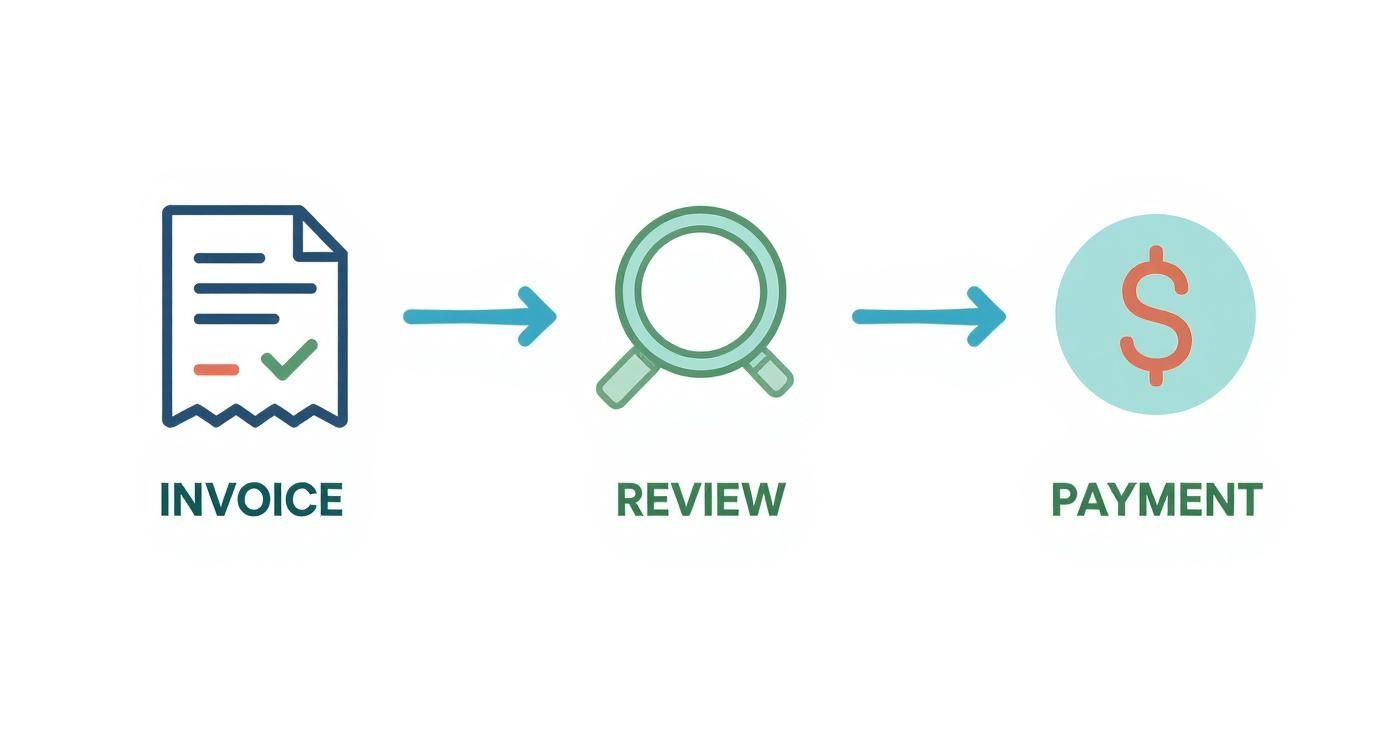
Each stage—from receiving the invoice to reviewing the details and finally sending the payment—is a checkpoint. These checks are what give you control over your company's finances.
To give you a clearer picture, this table breaks down the core stages and their purpose.
Key Stages of the AP Workflow
| Stage | Primary Objective | Key Best Practice |
|---|---|---|
| Invoice Receipt & Data Capture | Accurately get invoice details into your accounting system. | Use automation to scan invoices and reduce manual entry errors. |
| Verification & Matching | Confirm the invoice is legitimate and correct before approval. | Implement a three-way match against purchase orders and receiving reports. |
| Approval & Payment | Get authorization from the right person and pay the bill on time. | Establish clear approval hierarchies and schedule payments to optimize cash flow. |
Following these best practices turns your AP process from a simple administrative task into a strategic financial function.
Step 1: Invoice Receipt and Data Capture
It all starts the moment a vendor invoice arrives. It could be a paper copy in the mail or a PDF that lands in your inbox. Your first job is to get all the critical details from that document into your accounting software. This is called data capture, and it’s the foundation for everything that follows.
This is also where things can easily go wrong. Manually typing in the vendor name, invoice number, date, amount, and other details is tedious and prone to human error. A single misplaced decimal point or a typo in the invoice number can cause headaches later, leading to overpayments or confused vendors. Getting this step right is about creating a clean, accurate digital record.
Step 2: Invoice Verification and Matching
With the data entered, it's time to play detective. You need to verify that the bill is legitimate and accurate. A quick glance at the total isn't enough—the gold standard for this is the three-way match.
This is a powerful but simple cross-checking method that confirms an invoice is valid before a single dollar leaves your bank account. It works by comparing three separate documents:
- The Purchase Order (PO): This is your internal document that officially requested the goods or services in the first place.
- The Receiving Report: This confirms that you actually received what you ordered.
- The Vendor Invoice: This is the bill asking you to pay for it all.
When the quantity, price, and terms line up across all three documents, you can be confident that you’re paying the right amount for something you actually ordered and received. This simple practice is your best defense against paying for incorrect shipments, duplicate invoices, or even fraud.
Of course, not every bill comes with a purchase order. Think about your monthly rent or utility bills. For these, verification involves checking the amount against your contract or looking at past payments to spot any unusual spikes. Juggling these different checks can be a challenge, but the right bookkeeping tools for small businesses can make all the difference.
Step 3: Approval and Payment Processing
Once an invoice has been verified, it needs a final green light. For many small businesses, this is as simple as the owner or a manager giving a quick "okay." For larger companies, it might trigger a more formal approval workflow, where different people need to sign off depending on the department or the invoice amount.
After approval, the bill gets scheduled for payment in your accounting system. You get to decide when to pay it—immediately, or closer to the due date to hang onto your cash a little longer.
The final step is making the actual payment, whether you’re cutting a check, sending an ACH transfer, or using a company credit card. Once the payment is sent, the transaction is recorded in your books, and the AP cycle for that invoice is officially complete.
Common Roadblocks in Accounts Payable Management
Even the most organized accounts payable process can run into trouble, especially when you’re relying on manual work. For a small business, these snags aren't just little annoyances—they can mess with your cash flow, damage relationships with your suppliers, and create a whole lot of stress. Knowing what to watch out for is the first step to building a system that actually works.

One of the biggest culprits is simple manual data entry error. Think about it: someone has to key in invoice details by hand. A misplaced decimal or an extra zero is all it takes to accidentally overpay a vendor. These aren't just financial hits; they also take up precious time to hunt down and fix.
Then there's the chaos of lost or duplicate invoices. A paper invoice gets buried on a desk, or an email with an attachment gets accidentally deleted. Next thing you know, you're getting angry calls from vendors, facing late fees, and frantically digging through files to figure out what went wrong.
Approval Delays and Payment Fraud
Slow internal approvals create another massive bottleneck. If an invoice needs a physical signature and has to be passed from desk to desk—or worse, it’s sitting in a manager’s overflowing inbox—everything grinds to a halt. These delays can hurt your reputation with suppliers and mean you miss out on early payment discounts that could be saving you money.
But beyond these operational headaches lies a much more serious threat: payment fraud. This risk is particularly high for businesses that still rely on manual checks and outdated validation methods.
Payment fraud is a real and growing problem. A shocking 71% of businesses reported they were targets of payment fraud in 2023. This statistic alone should be a wake-up call, underscoring why strong, automated fraud detection needs to be part of any modern accounts payable workflow.
Dealing with these challenges isn't something you can put off. These problems tend to snowball. A duplicate invoice might get paid because the approval process was rushed, which only happened because the original bill was lost for two weeks. See how it works?
To keep these issues from wrecking your finances, you need solid controls and consistent oversight. Getting back to basics with some foundational small business accounting tips is a great place to start building a stronger financial foundation and protecting your business from these common—and completely preventable—roadblocks.
How AP Automation Transforms Your Workflow
Once you've felt the pain of a manual system—lost invoices, late fees, endless paperwork—the solution becomes obvious. Technology isn't a luxury anymore; it’s a core necessity for getting your accounts payable process under control. Think of AP automation as your most dependable employee, one who works 24/7 to crush the tedious, error-prone tasks that eat up your time and money.
Imagine a system that grabs invoice details with near-perfect accuracy, sends bills to the right person for approval with a click, and lines up payments automatically. That’s exactly what automation does. It transforms your AP department from a simple cost center into a strategic part of your business.

Tools like QuickBooks Online can act as a central command post for your payables, giving you a clear, immediate view of every dollar you owe.
Beyond Time Savings: The Real-World Benefits
Getting time back is the first thing you'll notice with automation, but the real magic goes much deeper. When you take manual data entry out of the equation, you slash the risk of expensive mistakes like paying the same bill twice or keying in the wrong amount. Better accuracy means stronger financial controls and a healthier bottom line.
Automation also gives you an incredible bird's-eye view of your company’s spending. With real-time data just a click away, you can make smarter cash flow decisions, negotiate better payment terms with suppliers, and catch unusual spending patterns before they spiral. This kind of insight is vital for financial health, a topic we cover in our guide to understanding cash flow statements.
Automation isn't just about speed; it's about intelligence. It's also your first line of defense against payment fraud by automatically flagging suspicious invoices and enforcing rigid approval rules. Your AP process becomes a safeguard, not a weak spot.
Automation in Action: A Practical Example
Let's look at a small manufacturing company here in Washington. They used to juggle dozens of supplier invoices every week. Their old process was a mess: print emails, type data into a spreadsheet, hunt down the floor manager for a signature, and then stuff envelopes to mail checks. Invoices got lost all the time, which meant late fees and unhappy vendors.
After they switched to an AP automation tool, their whole world changed:
- Step 1: Invoices now go to a dedicated email address, where software instantly pulls out all the important info. Tools like an AI Invoice Scanner can make this step almost instantaneous.
- Step 2: The system automatically checks the invoice against the original purchase order and flags any differences.
- Step 3: The floor manager gets a notification on his phone, reviews the details, and approves it digitally in seconds.
- Step 4: The payment is scheduled and sent electronically via ACH, and every detail is logged in their accounting software.
The impact was immediate. They cut their invoice processing time by a staggering 80%, completely eliminated late fees, and finally had a real-time, accurate picture of their outstanding bills. This isn't a unique story. The number of businesses with fully automated AP nearly doubled in just two years, and forecasts predict that 42% of AP departments will be fully automated soon. The trend is clear: this technology is becoming the standard.
Gaining an Edge with Professional Bookkeeping Services
Let's be honest, for most small business owners, managing accounts payable in-house feels like a constant uphill battle. It's a huge drain on your time and resources, pulling you away from what you do best. While automation is a fantastic step forward, the real game-changer is bringing in a professional bookkeeping service. This isn't just about offloading tasks; it's about plugging your business into a hub of financial expertise and top-tier technology without the hefty price tag of hiring a full-time finance team.
When you hand your payables over to a dedicated team like ours, you get experts who live and breathe this stuff. They’ll manage your workflow with an eye for both accuracy and strategic cash flow. Think of it this way: they make sure your bills are paid on time—never late—but not a day earlier than necessary. This keeps your cash in your account longer, strengthening your working capital and building solid relationships with your vendors. That kind of precision is what leads to smarter financial decisions. Our guide on the cost of goods sold actually dives deeper into how this level of control directly boosts your bottom line.
Ensuring Compliance and Focusing on Growth
Beyond just paying bills efficiently, a massive benefit is knowing you're always in compliance. Here in Washington State, for example, correctly handling B&O and excise taxes isn't just a suggestion—it's critical. A professional bookkeeper is always up-to-date on these rules, which can be a lifesaver, protecting you from audits and expensive penalties.
This isn't just a local issue, either. Governments worldwide are increasingly mandating electronic invoicing. In 2025, several countries are set to expand these e-invoicing requirements, which will have a direct impact on how businesses handle their accounts payable. You can get a better sense of these global AP trends on medius.com.
By outsourcing your accounts payable process, you're not just buying a service; you're buying back your time. This allows you to stop managing paperwork and start focusing on what truly matters—growing your business.
At the end of the day, working with a professional service gives you peace of mind. You know your financial back office is being handled correctly, which frees you up to pour your energy into innovation, serving your customers, and planning your next big move.
Got Questions? We’ve Got Answers.
We get it—accounts payable can feel like a maze of jargon. Here are some quick answers to the questions we hear most often from business owners, broken down into simple terms.
Key AP Concepts Explained
What’s the difference between accounts payable and accounts receivable?
Think of it this way: Accounts Payable (AP) is your company's "I Owe You" list. It's the money you owe to your vendors and suppliers for things you've already received, which makes it a liability on your books.
On the flip side, Accounts Receivable (AR) is your "They Owe Me" list. This is the money your customers owe you for the products or services you’ve delivered. It’s an asset because it’s cash that’s coming your way.
Simply put, AP is money going out, and AR is money coming in.
How does a good AP process actually improve cash flow?
A sharp, well-managed accounts payable process gives you a crystal-clear picture of exactly what you owe and when it's due. This isn't just about paying bills on time; it's about paying them at the right time.
By avoiding paying invoices too early and dodging costly late fees, you keep cash in your bank account longer. That improved working capital gives you flexibility and control, which is the lifeblood of any healthy business.
A strong accounts payable process isn't just about paying bills—it's about controlling the timing and flow of your outgoing cash to maximize financial stability and growth potential.
This financial control is what allows you to make smart, strategic decisions about where your money should go and when.
Ready to gain complete control over your accounts payable process without the daily hassle? The team at Bugaboo Bookkeeping offers expert, cloud-based bookkeeping services tailored for Washington State businesses. Schedule your free consultation today!