

To get a handle on the IRS crypto tax rules, there's one thing you absolutely have to understand first: the IRS sees your crypto as property, not currency. It’s a lot more like a stock, a piece of real estate, or even a collectible than it is like the cash in your wallet.
This single idea is the bedrock of all crypto taxation in the U.S. and it means almost everything you do with your coins—from selling Bitcoin for dollars to swapping some Ethereum for a promising new altcoin—is likely a taxable event.
Why the IRS Treats Your Crypto Like Property

This whole "property" thing isn't just a random choice; it's the foundation the IRS built for all crypto tax regulations. Back in 2014, they released Notice 2014-21, which officially laid out their position. Before that notice, it was a total gray area, and early crypto enthusiasts were pretty much flying blind when it came to taxes.
By calling virtual currency "property," the IRS made it clear that the existing rules for capital gains and losses would apply. This was a massive shift with huge consequences. Just like you owe capital gains tax when you sell a winning stock, you owe tax when you sell, trade, or spend your crypto for more than you paid for it. It also means that keeping detailed records isn't just a good habit—it’s an absolute necessity to stay on the right side of the IRS.
What This Means for You
Once you start thinking of your crypto as property, you can begin to see your tax obligations more clearly. It changes your perspective on everyday crypto activities, turning them into potentially significant financial moves in the government's eyes.
For example, buying a cup of coffee with Bitcoin isn't the same as using a dollar bill. From a tax standpoint, it’s like you sold a tiny fraction of your Bitcoin to the coffee shop. And that sale is a taxable event.
Here are the key things to remember from this core rule:
- Buying and Holding Is Fine: Simply buying crypto and holding it in your wallet doesn’t trigger any taxes. The clock only starts when you get rid of it.
- Every Sale or Trade Is a Big Deal: When you convert crypto back to U.S. dollars, trade one coin for another, or use it to buy something, you’ve just created a taxable event.
- Gains and Losses Are Key: The crucial number is the difference between what you originally paid for the crypto (your cost basis) and what you got for it when you sold or traded it. That difference is your capital gain or loss.
This guide is designed to be your map through this complex world. We’ll break down exactly what triggers a tax, how to figure out your gains and losses, and which forms you’ll need to file. Our goal is to give you the confidence to manage your crypto taxes correctly.
Truly letting this "crypto is property" concept sink in is the most important step you can take. It’s what stops you from making common, costly mistakes, like thinking crypto-to-crypto trades are tax-free (they're not!). And with expert help from a team like Bugaboo Bookkeeping, you can make this entire process easier, ensuring every transaction is tracked and reported according to the IRS crypto tax rules.
Identifying Your Crypto Taxable Events

The first step in getting your crypto taxes right is knowing exactly what actions trigger a tax bill. It's not as simple as just cashing out. The IRS views cryptocurrency as property, which means almost any transaction beyond simply buying and holding can create a taxable event.
Think of it like this: a taxable event is any moment where you "realize" a gain or loss. Whenever you dispose of your crypto, the IRS wants to know if its value changed since you first got it. That difference in value is what you owe taxes on. The term "disposing" is a lot broader than most people think, and it’s where a lot of the confusion begins.
The Obvious Tax Triggers: Selling and Trading
Let's start with the easy ones. The most common taxable event is selling your crypto for U.S. dollars. If you bought one Bitcoin for $30,000 and later sold it for $50,000, you have a $20,000 capital gain that you need to report. Simple enough.
But here’s a big one that trips people up: trading one cryptocurrency for another. Many investors assume these "crypto-to-crypto" trades aren't taxable because no cash ever hits their bank account. That’s a dangerous and incorrect assumption.
The IRS sees a trade of Bitcoin for Ethereum as two distinct moves:
- You essentially "sold" your Bitcoin for its fair market value at the exact moment of the trade.
- You then immediately used those proceeds to buy Ethereum.
You have to calculate and report the capital gain or loss on the Bitcoin you just "sold." Forgetting these trades is one of the easiest ways to get flagged for an IRS audit.
Less Obvious But Equally Important Taxable Events
Beyond straightforward sales and trades, a whole host of other activities create tax obligations. These are the tricky ones where people get into trouble, often without even realizing they've generated taxable income.
It’s all about diligent tracking, and many of the same principles for learning how to track business expenses can be applied here.
Here are a few common scenarios that absolutely count as taxable events:
- Paying for Goods or Services: That coffee you bought with crypto? Taxable event. The new laptop? Taxable. You're disposing of your crypto, and you have to calculate the gain or loss on the amount you spent.
- Receiving Crypto as Payment: If you own a business and a customer pays you in crypto, you've received income. You must report the fair market value of that crypto in U.S. dollars on the day you received it.
- Earning Staking Rewards: When you stake your crypto, the rewards you earn are considered income. You report their fair market value at the time they become available to you, not when you decide to sell them.
- Airdrops: Free tokens from an airdrop aren't really free. They're taxed as ordinary income based on their value when you gain control of them.
- Mining Income: For miners, the coins you successfully mine are treated as income. You report their value at the moment they were mined.
Key Takeaway: Any time you dispose of a cryptocurrency or receive it as income, you've likely created a taxable event. The only major exceptions are buying and holding crypto, or moving it between wallets you own.
To make things a bit clearer, here’s a quick-glance table summarizing how common activities are treated under current IRS crypto tax rules.
Common Crypto Transactions and Their Tax Implications
| Transaction Type | Is It a Taxable Event? | How Is It Typically Taxed? |
|---|---|---|
| Buying crypto with fiat currency | No | This establishes your cost basis. |
| Holding crypto | No | No gain or loss is realized until disposal. |
| Selling crypto for fiat | Yes | Capital gain or loss. |
| Trading one crypto for another | Yes | Capital gain or loss on the crypto you traded away. |
| Using crypto to buy goods/services | Yes | Capital gain or loss on the crypto you spent. |
| Earning staking or interest rewards | Yes | Ordinary income at the time of receipt. |
| Receiving an airdrop | Yes | Ordinary income at the time of receipt. |
| Transferring crypto between your own wallets | No | No change in ownership, so no tax is due. |
Keeping this table in mind as you transact can save you a world of headaches when tax season rolls around.
How to Calculate Your Crypto Gains and Losses
Now that you know what triggers a tax bill, the next step is running the numbers. The good news is that calculating your crypto gains and losses boils down to a surprisingly simple formula: you just subtract what you paid from what you got.
The two key terms you’ll hear over and over are cost basis and proceeds.
Think of your cost basis as the all-in price you paid to get your crypto. This isn't just the sticker price—it also includes any transaction fees, like exchange fees or network gas fees, that you paid along the way.
Formula: Cost Basis = (Price of Crypto) + (Any Transaction Fees)
Your proceeds are simply the fair market value of whatever you got in return when you sold, spent, or traded your crypto. If you sold for cash, it’s that dollar amount. If you swapped it for another crypto, it’s the fair market value of the new coin at that exact moment.
Formula: Capital Gain/Loss = (Sale Proceeds) – (Cost Basis)
If that number is positive, congratulations, you have a capital gain. If it’s negative, you’ve got a capital loss.
Getting Your Cost Basis Right
Your cost basis is the bedrock of every single crypto tax calculation. Mess this up, and everything that follows will be wrong. It’s absolutely non-negotiable for accurate reporting.
Let’s walk through a quick example. Imagine you bought 0.5 ETH for $1,500 and paid a $25 transaction fee.
- Your cost basis for that 0.5 ETH isn't just $1,500.
- It's actually $1,525 ($1,500 purchase price + $25 fee).
Forgetting to include those fees is one of the most common mistakes we see. It inflates your gains on paper and leads to you accidentally overpaying your taxes.
Short-Term vs. Long-Term Gains: Why It Matters So Much
The IRS looks at one crucial detail for every gain: how long did you hold the asset? This single factor can dramatically change how much tax you owe.
- Short-Term Capital Gains: This is for any crypto you held for one year or less before selling. These gains are taxed at your ordinary income tax rates—the same bracket as your job’s salary.
- Long-Term Capital Gains: This applies to crypto held for more than one year. These get preferential treatment with much lower tax rates: 0%, 15%, or 20%, depending on your income level.
The difference here is huge. A high-income earner could be staring at a 37% tax rate on short-term gains but only 20% on long-term gains. That’s why the holding period for every single transaction is a critical piece of the puzzle.
Choosing an Accounting Method
So, what happens when you buy Bitcoin at five different prices throughout the year and then sell just a fraction of your holdings? Which cost basis do you use? This is where accounting methods come in. The IRS lets you pick a method, but the key is that you have to stick with it.
For crypto, the most common and straightforward method is First-In, First-Out (FIFO). Just like it sounds, this method assumes the first coins you bought are the first ones you sell.
Here’s how FIFO works in the real world:
- January: You buy 1 BTC for $30,000.
- June: You buy 1 BTC for $40,000.
- October: You sell 1 BTC for $50,000.
Using FIFO, the tax man assumes you sold the Bitcoin from January. That means your cost basis is $30,000, and your capital gain is $20,000 ($50,000 – $30,000).
While FIFO is the default, some savvy investors use Specific Identification, which allows you to hand-pick which specific coins you're selling. This demands incredibly detailed records, but it can be a powerful tax strategy, letting you sell coins with a higher cost basis to minimize your taxable gains.
The Nightmare of Manual Tracking
As you can see, every single trade generates a pile of data you need to keep: date acquired, date sold, cost basis, and sale proceeds. If you’re an active trader, this can easily spiral into hundreds or even thousands of transactions scattered across a dozen exchanges and wallets.
Trying to track all this in a spreadsheet is more than just a headache—it’s a recipe for disaster. One simple copy-paste error or a mistake in a cost basis formula can throw off your entire tax return. This is precisely why specialized software isn't just a convenience; it's a necessity. You can check out this helpful crypto tax software comparison to get a sense of the tools out there.
For investors in Washington, this is the problem Bugaboo Bookkeeping was built to solve. We use professional-grade tools like Koinly to securely connect to all your exchanges and wallets, pulling in every transaction automatically. From there, our job is to reconcile the data, calculate the correct cost basis for every single disposal, and generate the clean gain and loss reports your CPA needs. We turn a chaotic, stressful mess into a seamless, audit-proof process, making sure you stay fully compliant with all IRS crypto tax rules.
Reporting Your Crypto on the Right IRS Forms
After you've done the hard work of tracking and calculating your gains and losses, the final piece of the puzzle is reporting it all to the IRS. This is where your careful record-keeping pays off, turning your transaction history into official government paperwork. Getting this part right is crucial for staying compliant with IRS crypto tax rules, and it really boils down to just a few key forms.
The main stage for reporting capital gains and losses from assets like crypto is Form 8949, Sales and Other Dispositions of Capital Assets. Think of this form as a detailed logbook for every single taxable event. You have to list each crypto sale, trade, or purchase you made—what you sold, when you bought it, the date you sold it, what you got for it, and what you originally paid.
This flowchart shows the simple math behind every single line item on your Form 8949.
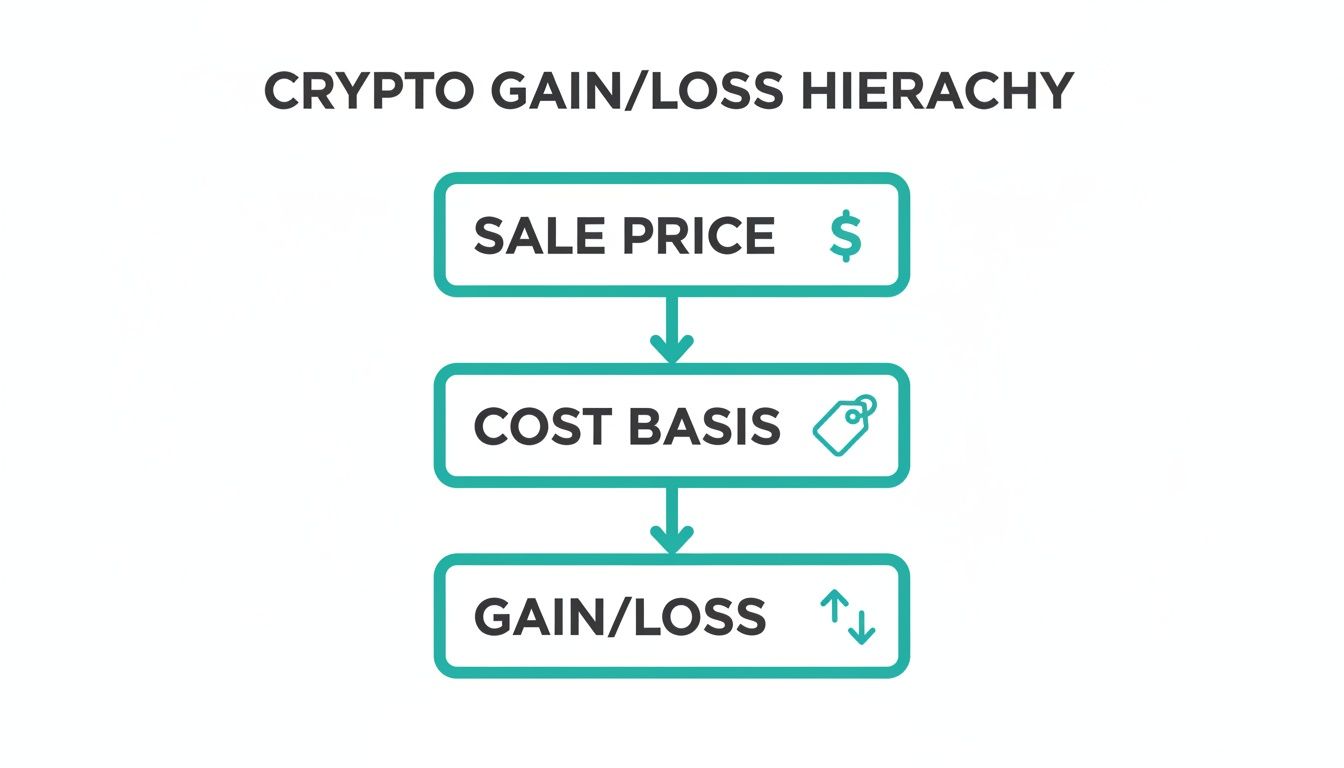
It’s a straightforward formula, but one that you have to get right every time: your proceeds minus your cost basis equals your taxable gain or loss. This number is the core of your crypto tax reporting.
From Form 8949 to Your Final Tax Return
Form 8949 doesn't exist in a vacuum; it’s the starting point. The numbers from this form flow through your tax return in a logical sequence, moving from granular detail to a final summary. If tax forms have ever seemed intimidating, just remember it's all about information moving from one place to the next.
Here’s how the data travels:
- Form 8949: This is where you list every individual transaction. It has columns for the asset description (like "0.5 Bitcoin"), date acquired, date sold, proceeds, and cost basis.
- Schedule D: Next, the totals from Form 8949 are summarized on Schedule D, Capital Gains and Losses. This form separates your short-term and long-term activity and provides a combined total for all your capital assets, not just crypto.
- Form 1040: Finally, the net gain or loss from Schedule D makes its way to your main tax return, Form 1040. This is where your crypto profits or losses officially factor into your overall taxable income and determine what you owe.
Trying to manage this data flow by hand, especially if you're an active trader, can become a nightmare pretty quickly. It helps to get your transaction data organized first, much like you'd learn how to import transactions into QuickBooks Online for managing business finances.
The Critical Digital Asset Question
Since 2020, the IRS has made it impossible to ignore your crypto obligations by placing a question front and center on Form 1040. It asks every U.S. taxpayer: "At any time during [the tax year], did you: (a) receive (as a reward, award, or payment for property or services); or (b) sell, exchange, or otherwise dispose of a digital asset (or a financial interest in a digital asset)?"
You can't skip this. You have to check "Yes" or "No."
Heads Up: Ticking "No" when you actually had taxable crypto activity is a huge red flag. The IRS considers this filing a fraudulent return, which can open you up to serious penalties, audits, and even perjury charges. They put that question there for a reason—to catch people who aren't reporting.
This question is a clear signal that the agency is watching digital asset transactions closely. It’s the final checkpoint, ensuring no one can claim they "didn't know" they had to report. This is exactly where services from Bugaboo Bookkeeping can give you peace of mind. We handle the painstaking work of preparing your Form 8949, ensuring every last transaction is accounted for. That way, you can confidently check "Yes" knowing you have the bulletproof documentation to back it up.
Avoiding Common Crypto Tax Mistakes and Penalties
Diving into crypto taxes can feel like navigating a minefield. It's easy to make a wrong step, and even honest mistakes can end up being expensive. These aren't just small slip-ups; they’re the kinds of errors that catch the IRS's attention and can lead to some serious financial headaches. Knowing where others go wrong is the best way to stay on the right path.
One of the biggest blunders we see is people forgetting to report their crypto-to-crypto trades. The thinking is usually, "No cash came out, so no tax is due, right?" Unfortunately, that's not how the IRS sees it. Every single time you swap one cryptocurrency for another, you've technically "sold" the first one, which triggers a taxable event.
Another classic mistake is messing up the cost basis calculation. This happens all the time when you move coins between different exchanges or personal wallets. If you're not keeping perfect records, figuring out the original purchase price and any associated fees becomes a nightmare, which leads straight to inaccurate gain or loss reporting on your tax return.
The Real Cost of Getting It Wrong
So, what happens if you make one of these mistakes? Let’s just say the IRS doesn’t take it lightly. Pleading ignorance won't get you very far. The most common consequence is the accuracy-related penalty, which can tack on an extra 20% to the tax you underpaid.
And that's for simple errors. For bigger issues, the penalties get much steeper. The IRS has poured a ton of resources into crypto tax enforcement, even creating a special task force called Operation Hidden Treasure to find taxpayers who aren't reporting their transactions. An audit isn't just a financial burden; it's an incredibly stressful and time-consuming process.
Think of getting professional tax help as a form of insurance. It's an upfront cost, but it shields you from the potentially massive financial and personal fallout of an IRS audit or penalty. An expert can make sure your return is buttoned up and ready for scrutiny.
Underreporting Income from Yields and Rewards
Trading isn’t the only area where people get tripped up. Forgetting to report income from staking, mining, or DeFi interest is a huge one. This isn't a capital gain—it's ordinary income, taxed based on the crypto's fair market value the moment it hits your wallet.
A lot of people assume this income is only taxed when they finally sell the rewarded coins. The reality is, you owe tax on it in the year you received it. That income also establishes a new cost basis for those coins, which you'll need later when you calculate capital gains on a future sale.
This all goes back to March 2014, when the IRS dropped Notice 2014-21 and officially declared that crypto is property, not currency. That was the game-changer, making every crypto disposal a potential capital gains event, just like selling a stock. To give you an idea of the initial confusion, fewer than 1,000 taxpayers reported crypto gains between 2013 and 2015.
Staying on top of this requires the same kind of careful record-keeping as organizing business receipts for tax purposes. This is where having a specialist like Bugaboo Bookkeeping in your corner makes all the difference. We can act as your safety net, ensuring every trade, reward, and transaction is tracked and reported correctly to keep you out of trouble.
Get Your Crypto Taxes Done Right With Bugaboo Bookkeeping
Trying to make sense of the IRS's crypto tax rules can feel like you’re trying to solve a puzzle with half the pieces missing. The regulations are a moving target, and the consequences of getting it wrong are steep. This is where we come in. At Bugaboo Bookkeeping, we act as your guide, transforming that overwhelming complexity into straightforward, confident tax filing.
We know that no two crypto investors are the same. Your journey—and your transaction history—is unique. That's why we always start with a free consultation to get the full picture of your situation. Once we understand your needs, we take the wheel.
From Messy Data to Audit-Proof Reporting
Our main goal is to take the entire compliance burden off your plate. We don't just hand you a piece of software and send you on your way; we roll up our sleeves and manage the entire reconciliation process for you.
Here’s how we deliver that tax-season peace of mind:
- Seamless Data Integration: We use powerful, specialized tools like Koinly to securely pull in your complete transaction history from every single exchange and wallet you’ve ever used.
- Meticulous Reconciliation: Our experts then comb through your data line by line. We meticulously review and reconcile every transaction, ensuring each cost basis is calculated perfectly and no taxable event slips through the cracks.
- Accurate Form 8949 Preparation: Finally, we generate a clean, comprehensive, and perfectly accurate Form 8949 for your tax return. This alone can save you and your CPA countless hours of tedious work.
This hands-on approach has never been more important. The IRS is paying very close attention to crypto. Their scrutiny ramped up after the 2018 Virtual Currency Compliance Campaign, which resulted in over 10,000 warning letters being sent to taxpayers. Now, with that crypto question front and center on Form 1040, accurate reporting is simply not optional. If you want to understand the current climate, it's worth reading up on the history of IRS crypto tax enforcement.
Your Washington-Based Crypto Tax Experts
We're not new to this. With over 20 years of experience serving investors and small businesses across Washington State, our high client retention rate speaks for itself. We provide the kind of detailed, crypto-specific support that most general bookkeepers simply can't offer, making sure every single detail is right. You can explore our general approach to see how we help clients stay organized with our outsourced bookkeeping for small businesses.
Let us handle the tedious, intricate details of crypto tax compliance. You get the confidence that your taxes are filed correctly, so you can get back to focusing on your investment strategy—not deciphering IRS regulations.
Crypto Tax FAQs: Your Top Questions Answered
Even when you feel like you've got a handle on the rules, crypto taxes can throw some curveballs. Let's tackle some of the most common questions that pop up when you're trying to apply IRS guidelines to your own portfolio.
Do I Owe Taxes if I Just Buy and HODL?
Nope. Just buying crypto with U.S. dollars and holding on for dear life isn't a taxable event. The IRS doesn't get involved until you actually do something with it.
Think of it just like buying a stock. You don't pay taxes on its value going up until you sell it and lock in that profit. The tax clock only starts ticking when you dispose of your crypto—that means selling it, trading it for another coin, or using it to buy something.
What if I Lost Money on My Crypto Investments?
Losing money on a trade is never fun, but there's a silver lining when it comes to taxes. You can put those crypto capital losses to work for you. They can be used to cancel out capital gains from other sales, whether that's from crypto, stocks, or other investments.
And if your losses for the year are bigger than your gains? You can deduct up to $3,000 of that excess loss against your regular income, like your salary. Any loss left over after that gets carried forward to future years, ready to offset gains down the road. This is what's known as tax-loss harvesting, and it's a smart strategy for any serious investor.
Using losses to offset gains is a core principle of how property is taxed. That’s why tracking your losses with the same attention to detail as your gains is so important—it can directly reduce how much you owe the IRS.
Can I Deduct Crypto Transaction Fees?
Yes, you can, though maybe not in the way you'd expect. You don't list them out as separate deductions. Instead, transaction fees—like exchange commissions or network gas fees—get baked right into your calculations.
Here’s the breakdown:
- When you buy: The fee gets added to your cost basis. This bumps up the official purchase price of your crypto.
- When you sell: The fee is subtracted from your sale proceeds. This lowers your official sale price.
Either way, it helps you out. By increasing your cost or decreasing your proceeds, these fees shrink your potential capital gain, which means a smaller tax bill. It's a perfect example of why tracking the small stuff matters.
What Records Should I Be Keeping for My Crypto?
The IRS is serious about record-keeping. If you ever face an audit, you need to have your ducks in a row, or you could be looking at penalties.
For every single transaction, you need to have documentation showing:
- The date it happened.
- The specific crypto and amount you bought, sold, or traded.
- Its fair market value in U.S. dollars at that exact moment.
- What the transaction was for (a sale, a trade for another coin, a staking reward, etc.).
- A record of any transaction fees you paid.
Trying to manage all these rules and keep flawless records can feel like a full-time job. Bugaboo Bookkeeping takes that entire burden off your shoulders. We can import your trades, untangle your cost basis, and prepare a clean, audit-proof Form 8949 for you. Let us give you some well-deserved peace of mind this tax season. Learn more about our crypto tax services and schedule your free consultation today!