At its core, the difference between accounts payable vs. accounts receivable is simple. Accounts Payable (AP) is the money your business owes to its suppliers for goods or services you bought on credit. On the flip side, Accounts Receivable (AR) is the money your customers owe you for the products or services you’ve already sold them.
The Two Sides of Every Transaction

It helps to think of AP and AR as two sides of the same coin. When you purchase supplies from a vendor on credit, that vendor logs an accounts receivable on their books. At the exact same moment, you log an accounts payable for that same amount on your books. One company’s asset is simply another’s liability, creating a perfectly balanced financial seesaw.
This duality is a cornerstone of accrual accounting, a method where you recognize revenue and expenses when the transaction happens, not necessarily when the cash actually moves. Getting a firm grip on these concepts is one of the most important bookkeeping basics for small business owners, as they offer a true picture of your company’s financial health.
Defining AP as a Liability
Accounts payable represents your company's short-term financial promises. On your balance sheet, it’s classified as a current liability because it's a debt you’re expected to settle within a year.
Smart AP management is more than just paying bills; it's a strategic process. It involves carefully tracking vendor invoices, verifying every charge for accuracy, and scheduling payments to dodge late fees while keeping your suppliers happy.
Defining AR as an Asset
Conversely, accounts receivable is the money flowing into your business, which is why it’s considered a current asset. It represents the cash you’ll collect in the near future, typically within the next year. A tight AR process ensures you get paid on time, which is absolutely critical for maintaining a healthy cash flow.
At the end of the day, managing AP and AR is really about controlling the flow of money in and out of your business. Mastering both isn't just good practice—it's essential for financial stability and growth.
To really get the hang of these processes, it’s also useful to understand the fundamental differences between invoices and receipts, since these are the documents that drive everything in the AP and AR world.
For a quick summary, this table breaks down the main distinctions at a glance.
AP vs AR Key Distinctions
| Attribute | Accounts Payable (AP) | Accounts Receivable (AR) |
|---|---|---|
| Financial Nature | Money you owe | Money owed to you |
| Balance Sheet | Current Liability | Current Asset |
| Related To | Purchases from suppliers | Sales to customers |
| Cash Flow Impact | Represents cash outflow | Represents cash inflow |
| Goal of Management | Control spending and pay on time | Collect payments quickly |
Seeing them side-by-side really clarifies how these two accounts are mirror images of each other, each playing a crucial but opposite role in your company's finances.
How AP and AR Show Up on Your Financial Statements
Accounts Payable and Accounts Receivable aren't just lists of who you owe and who owes you. They're the lifeblood of your financial story, directly shaping how your business's health and performance are reported. Think of them as the core gears in the engine of accrual accounting.
With accrual accounting, we record transactions the moment they happen—not just when money finally changes hands. This gives a much truer picture of your profitability, and it’s AP and AR that make it all possible by capturing your obligations and earnings as they occur.
AP and AR on the Balance Sheet
The balance sheet is a snapshot in time of what your company owns (assets), what it owes (liabilities), and the owner's stake (equity). AP and AR have starring roles here.
-
Accounts Receivable (AR) sits under current assets. An asset is anything your company owns that has economic value. AR represents the money your customers have promised to pay you for work you've already done. We call it a "current" asset because you expect to turn that promise into actual cash within a year.
-
Accounts Payable (AP) is listed under current liabilities. A liability is simply a debt—something your company owes. AP is your short-term obligation to pay suppliers for things you've already received. It’s "current" because you'll typically pay these bills within the year.
Just looking at these two numbers can tell you a lot about how smoothly your business is running. A high AR figure might look impressive, but if your customers aren't paying on time, it's not doing you much good.
Working Capital and Your Ability to Pay Bills
The relationship between your current assets and current liabilities directly feeds into your working capital, which is a crucial measure of your company's short-term financial stability. The formula couldn't be simpler:
Working Capital = Current Assets – Current Liabilities
A healthy, positive working capital number means you have more than enough short-term assets to cover your short-term debts. Since AR beefs up your current assets and AP increases your current liabilities, managing their balance is critical. This is the heart of liquidity—your ability to meet cash obligations as they come due.
The goal is a constant balancing act: turning your AR into cash as quickly as possible while strategically timing your AP payments to keep cash on hand.
A Practical Look at Journal Entries
Let’s walk through a real-world example to see how this works on the books. Imagine your graphic design agency buys a new software subscription for $1,000 on credit.
1. Recording the Payable (When You Get the Bill):
You received the invoice, so you've incurred the expense even though you haven't paid yet. The journal entry looks like this:
- Debit: Software Expense for $1,000 (This increases your expenses on the income statement)
- Credit: Accounts Payable for $1,000 (This increases your liabilities on the balance sheet)
2. Paying the Bill:
A month later, you pay the invoice. Now you're settling that debt:
- Debit: Accounts Payable for $1,000 (This wipes out the liability)
- Credit: Cash for $1,000 (This reduces your cash balance)
Now, let's flip it around. You finish a design project and send your client an invoice for $5,000.
1. Recording the Receivable (When You Send the Invoice):
The moment you send that invoice, you've earned the money. The journal entry is:
- Debit: Accounts Receivable for $5,000 (This increases your assets)
- Credit: Service Revenue for $5,000 (This increases your revenue)
2. Getting Paid by the Customer:
When your client's payment hits your bank account, you convert that IOU into cash:
- Debit: Cash for $5,000 (Your cash balance goes up)
- Credit: Accounts Receivable for $5,000 (Your receivable asset goes down because the debt is settled)
These simple entries ripple across all your financial statements, impacting your balance sheet, income statement, and cash flow. To get a better sense of how it all connects, take a look at our guide on understanding cash flow statements.
A Tale of Two Lifecycles: The AP and AR Workflows
To truly grasp the difference between accounts payable and accounts receivable, you have to look past the balance sheet definitions and dig into their day-to-day operational flows. Think of them as two sides of the same coin: one process manages money going out, the other manages money coming in. They are distinct, yet perfectly mirrored.
The AP lifecycle is all about reaction. It doesn't start until someone else—a vendor or supplier—sends you a bill. The whole process is built around verifying that demand for payment. In stark contrast, the AR lifecycle is proactive. Your company kicks it off by sending an invoice to a customer to collect the money you've rightfully earned.
Both processes end with cash changing hands, but the journey to get there couldn't be more different. This diagram shows how these activities ripple through your company's core financial statements.
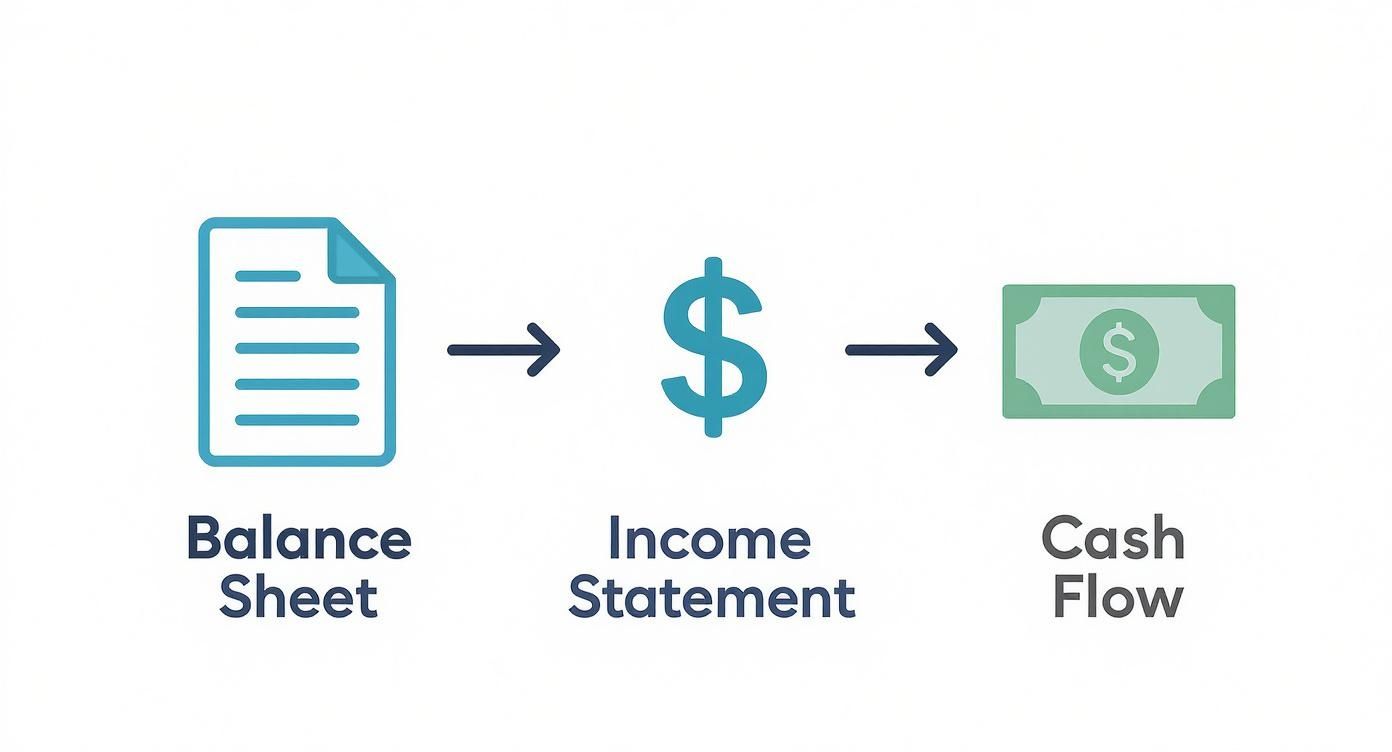
As you can see, AP and AR transactions first hit the Balance Sheet (as liabilities or assets) and the Income Statement (as expenses or revenues). But it's not until the cash is actually paid or received that you see the impact on your Cash Flow Statement.
The Accounts Payable Workflow: From Invoice to Payment
The AP process is a disciplined, step-by-step procedure for validating and paying what you owe to vendors. The main goal here is control and accuracy—you want to stamp out any chance of overpayments, fraud, or late fees. Every step is a checkpoint to make sure you only pay for what you actually ordered and received.
Here’s what a standard AP lifecycle looks like:
-
Invoice Receipt and Capture: It all starts when a supplier’s invoice lands on your desk (or, more likely, in your inbox). The first job is to get that invoice data into your accounting system.
-
Verification and Three-Way Match: This is where the real gatekeeping happens. Your team matches the invoice against the original purchase order (PO) and the receiving report that confirms the goods arrived. This "three-way match" is your proof that you were billed for the right stuff, at the right price, and that you actually got it.
-
Approval: Once everything checks out, the invoice gets sent to the relevant manager for a final sign-off. This step confirms the expense was necessary and gives the green light to pay it.
-
Payment and Reconciliation: With approval in hand, the payment is scheduled and sent out. The last step is recording the transaction in the general ledger, which clears the payable and reduces your cash balance.
Key Takeaway: Think of the AP lifecycle as playing defense with your money. Success is all about meticulous verification to protect your cash and prevent it from leaving the company unnecessarily.
The Accounts Receivable Workflow: From Invoice to Collection
The AR process is AP's offensive counterpart. The entire workflow is built around one thing: converting your sales into cash as fast as humanly possible. This is a game of speed, clear communication, and a little bit of persistence to make sure your business gets paid on time.
The AR lifecycle typically unfolds like this:
-
Invoice Creation and Delivery: As soon as you complete a service or ship a product, the clock starts. The AR team needs to generate a spot-on invoice and get it to the customer immediately. The sooner they get the bill, the sooner you can get paid.
-
Payment Tracking: Once the invoice is out, your system keeps an eye on it, tracking the due date and watching for payments. When cash comes in, it's carefully applied to the correct outstanding invoices in that customer's account.
-
Collections Management: The moment an invoice goes past its due date, the collections process kicks in. This usually starts with automated reminders and can escalate to more direct follow-ups—a process known as dunning procedures—to secure the payment.
-
Cash Application and Reporting: Finally, when the customer pays, that cash is applied to their open receivable, clearing their debt. The transaction is logged, boosting your cash balance and reducing the AR asset on your balance sheet.
Essential KPIs for Managing AP and AR
You can't manage what you don't measure. When it comes to accounts payable and accounts receivable, Key Performance Indicators (KPIs) are your financial diagnostic tools. They tell you exactly what's going on with your cash flow and how efficient your back-office operations really are. Tracking these metrics is how you turn raw data into a smart, actionable strategy.
With accounts payable, the game is all about optimizing your cash outflow. You want to pay vendors on time to keep them happy and dodge late fees, but not so quickly that you drain your cash reserves unnecessarily. Think of solid AP management as a strategic lever for protecting your working capital.
On the other side of the coin, accounts receivable KPIs are focused on one thing: speeding up cash inflow. The whole point is to turn your sales into actual cash in the bank as fast as possible, minimizing the time your money is just an IOU on someone else's books.
Let’s dig into the essential metrics for both.
Key Metrics for Accounts Payable Performance
Keeping a tight rein on your payables means watching how long you take to pay bills and how smoothly that process runs. These KPIs will give you a clear snapshot of your AP health.
-
Days Payable Outstanding (DPO): This is the big one for AP. DPO tells you the average number of days it takes your company to pay its suppliers. A higher DPO is often good because it means you're holding onto your cash longer, which helps with liquidity. But be careful—if your DPO gets too high, it's a red flag that you're paying late, which can sour your relationships with vendors. The sweet spot is a balance that keeps cash in your hands without making you a "problem customer."
-
Early Payment Discount Capture Rate: A lot of suppliers will offer a small discount, like 2% off, if you pay an invoice early. This KPI tracks how often you're actually grabbing those discounts. A low rate here means you're literally leaving free money on the table, usually because your invoice approval workflow is too slow or disorganized.
Top Indicators for Accounts Receivable Health
AR metrics are all about collection speed and effectiveness. They show you how quickly customers are paying up and help you spot collection issues before they snowball into major problems.
-
Days Sales Outstanding (DSO): As the direct counterpart to DPO, this metric calculates the average number of days it takes for you to collect payment after making a sale. In almost every case, a lower DSO is better. It's a direct indicator that cash is flowing into your business faster. If you see your DSO start to creep up, consider it an early warning sign of collection trouble ahead.
-
Collection Effectiveness Index (CEI): This one gives you a much more nuanced picture than DSO. The CEI compares how much cash you actually collected in a period against the total amount of receivables that were available to be collected. It produces a simple percentage that shows how good your team is at bringing in the money they’re supposed to.
The A/R Aging Report: A Critical Diagnostic Tool
If you only use one tool in your AR toolkit, make it the A/R aging report. This simple report is indispensable. It sorts all your outstanding customer invoices into columns based on how long they've been overdue—typically 0-30 days, 31-60 days, 61-90 days, and 90+ days. It provides an immediate, at-a-glance view of who owes you money and just how late they are.
To see how these numbers ultimately flow through to your bottom line, take a look at our guide on understanding profit and loss statements.
Here's an example of what an A/R aging summary looks like, breaking down what's owed by customer and how overdue it is.
:max_bytes(150000):strip_icc()/dotdash_Final_Accounts_Receivable_Aging_Jan_2021-01-a203f3933c2a4788981f964359d2906d.jpg)
This report instantly flags which accounts need your immediate attention. Time is not your friend here; the longer an invoice goes unpaid, the less likely you are to ever collect on it.
Historical data is pretty clear: once a receivable is over 90 days past due, the chance of it becoming bad debt skyrockets. In fact, companies with over 22% of their receivables in that 90+ day bucket often see write-off rates three to four times higher than their peers.
Making a habit of reviewing your aging report lets you manage collections proactively, not reactively. You can spot customers who are consistently slow to pay and make smarter decisions about who you extend credit to in the future. It’s the closest thing you have to a treasure map for your company's cash inflow.
Automating AP and AR for Greater Efficiency
Let’s be honest: manually keying in data for accounts payable and receivable is a soul-crushing task. It's not just tedious—it's an expensive bottleneck riddled with the potential for human error. Moving away from paper invoices and clunky spreadsheets to modern software isn't just an upgrade; it can completely reshape your financial operations for the better.
The real point of automation isn’t just to work faster. It’s about building smarter, more reliable workflows that give you a crystal-clear picture of your cash position at any given moment. This frees up your time to focus on growing the business, not getting buried in administrative busywork.
The Tangible Benefits of Automation
Bringing in automation tools pays dividends on both sides of the ledger. For AP, it means fewer late payment penalties and the ability to grab early payment discounts. For AR, it translates to getting paid faster and maintaining a healthier cash flow.
Here’s what you stand to gain:
- Reduced Human Error: Automation gets rid of the typos and data entry mistakes that cause overpayments or delayed collections.
- Faster Processing Times: Invoices get captured, approved, and paid in a fraction of the time it takes to do it all by hand.
- Clearer Cash Flow Visibility: Real-time dashboards give you an up-to-the-minute view of your outstanding payables and receivables.
- Stronger Relationships: Paying suppliers on time keeps them happy, while friendly invoice reminders help customers pay you on schedule without any awkward phone calls.
The shift to automation is picking up serious steam. The global accounts payable automation market hit $3.08 billion in 2023 and is only expected to climb. Yet, a surprising 37% of businesses still rely on paper invoices, meaning that 57% of their invoice data is typed in manually.
Automation transforms AP and AR from reactive, administrative functions into proactive, strategic assets. It's about gaining control over your cash flow, not just processing paperwork.
Practical Automation in Action
You don't need a massive budget to get started. Modern accounting platforms like QuickBooks Online have powerful, built-in features that make automation easy for any small business. A great first step for your AP process is to automate invoice processing, which can make a huge difference right away. These tools can take on tasks that once ate up hours of your day.
Think about these common automated workflows:
- Automated Invoice Reminders (AR): Instead of manually tracking who owes you what, you can set up software to send polite reminders as due dates approach (and pass). No more chasing payments.
- Recurring Bill Payments (AP): For predictable monthly expenses like rent or software subscriptions, schedule automatic payments. You’ll never worry about a late fee again.
- Digital Approval Workflows (AP): Forget passing paper invoices around the office. Software can route bills to the right person for approval, sending notifications and creating a clear audit trail.
More advanced tools can do even more. Optical Character Recognition (OCR) technology, for instance, can scan a PDF invoice, pull out key details like the vendor, date, and amount, and plug it straight into your accounting system. This one feature alone dramatically cuts down on manual data entry. For more tips on getting your finances in order, take a look at our guide on essential small business accounting tips.
When Does It Make Sense to Outsource AP and AR?
If you’re a small business owner, you know the feeling. Managing who you owe and who owes you can feel like a second, unpaid job. What started as a few invoices a week has probably ballooned into a major time suck, pulling you away from what you’re actually good at—running your business.
Knowing when to pass the torch on these financial tasks isn't just about saving time; it's a strategic move to protect your cash flow and, honestly, your sanity. The decision often becomes painfully obvious when you start seeing the warning signs.
Have You Reached the Tipping Point?
Are you paying your suppliers late? That’s not just an accounting issue; it damages the relationships you depend on. On the flip side, are your customer invoices starting to collect dust, aging past 60 or even 90 days? Every day an invoice goes unpaid is a direct hit to your bank account.
Another huge red flag is constant bookkeeping mistakes. If you find yourself spending hours hunting down errors or your reconciliations never quite add up, it’s a clear signal that the financial complexity of your business has outgrown your available time or expertise. These aren’t just little annoyances—they can have serious financial consequences.
Outsourcing isn't giving up; it's getting smart. When the time you spend on financial admin starts costing you more in lost opportunities than a professional's fee, you’ve hit the tipping point.
This is especially true when you factor in all the hidden costs of DIY bookkeeping for business owners, from missed growth chances to straight-up burnout.
The Real-World Benefits of Bringing in a Pro
Handing over your books to a service like Bugaboo Bookkeeping is about more than just getting time back. You're plugging into a team of experts whose entire job is to master the accounts payable vs accounts receivable puzzle.
Here’s what that actually looks like for your business:
- Healthier Cash Flow: A pro ensures your customer invoices get collected on time (AR) and your bills get paid strategically (AP), keeping your working capital strong.
- Fewer Headaches, Better Accuracy: Expert bookkeepers drastically cut the risk of expensive errors. Your financial records will be clean, accurate, and ready for anything—from a loan application to an audit.
- Focus on What Matters: When you're not buried in spreadsheets, you and your team can put 100% of your energy into revenue-generating activities like sales and customer service.
- Instant Process Upgrades: A dedicated firm already has efficient workflows and knows the best software. They can improve your financial operations from day one without the steep learning curve.
At the end of the day, outsourcing lets you build a stronger, more scalable financial foundation for your business by leaning on people who live and breathe this stuff.
AP vs. AR: Your Questions Answered
Even after you get the hang of the basics, real-world questions about accounts payable and receivable always pop up. Here are some of the most common ones I hear from business owners, along with straightforward, practical answers.
Can a Business Have High Accounts Receivable and Still Face Cash Flow Problems?
Yes, absolutely. This is a classic trap that even successful, growing businesses fall into. High accounts receivable might look fantastic on your profit and loss statement—it means you’re making a lot of sales—but it’s not cash in the bank.
If your customers take their sweet time paying you, you can be "profitable" on paper but still not have the money to make payroll or pay your rent. This is the critical difference between revenue and actual cash flow, and it’s why a solid collections process is non-negotiable.
What Is the Biggest Mistake Businesses Make with Accounts Payable?
Hands down, the most common and costly mistake is messy invoice management. When there's no clear system for tracking and approving invoices, two things happen: you get slapped with late fees, and you miss out on early payment discounts.
Think about it—many suppliers offer terms like "2/10, n/30". That’s a 2% discount just for paying within 10 days. A disorganized AP process means you're literally leaving free money on the table, which eats directly into your profits.
How Do AP and AR Management Affect My Business Credit?
Your accounts payable history has a direct and significant impact on your business credit score. Payment history is a huge factor, and credit bureaus look closely at whether you pay your suppliers on time. Consistent, on-time payments build a strong credit profile; late payments will drag it down fast.
Accounts receivable, on the other hand, doesn't directly build your credit. But poor AR management can cause a domino effect. If you can't collect cash from your customers, you might not have the funds to pay your own bills, which then damages your credit score.
Which Is More Important to Manage: Accounts Payable or Accounts Receivable?
This is like asking if breathing in is more important than breathing out. You need both to survive. AP and AR are two sides of the same coin: your cash flow cycle.
AR management is all about getting cash into the business. AP management is about strategically controlling when that cash flows out. If you neglect AR, you starve the business of cash. If you neglect AP, you let it bleed out. Both demand your attention.
Juggling the demands of both AP and AR can feel like a full-time job in itself. Bugaboo Bookkeeping offers expert, cloud-based bookkeeping services designed to keep your cash flow healthy and your records pristine. Let our experienced team handle the details so you can get back to growing your business. Learn more about our bookkeeping services for small businesses.