
Imagine your business has a report card. A Profit and Loss (P&L) statement is exactly that—it tells you how well your business performed financially over a specific period, whether that's a month, a quarter, or an entire year. It’s not just a boring spreadsheet; it’s the story of whether you won or lost the game of profitability during that time.
Getting a handle on this document is the first real step toward making smarter decisions and driving actual growth.
What a P&L Statement Reveals About Your Business

At its heart, a Profit and Loss statement (you'll also hear it called an "income statement") adds up all your revenue and subtracts all your expenses over a set timeframe. The number left at the bottom is the one everyone cares about: your net profit or loss.
This isn't a static snapshot like a balance sheet, which shows your financial position on a single day. Instead, the P&L tells a dynamic story of how effectively you ran your business from one point in time to another. Every entrepreneur, from a solo freelancer to a CEO with a team of 20, needs to understand this report inside and out.
The Three Pillars of Your Financial Story
To really get it, you just need to focus on three core pillars: revenue, expenses, and profit. They're the main characters in your business's financial narrative.
To give you a quick cheat sheet, here’s a simple breakdown of what each component means and why it matters.
Key Components of a Profit and Loss Statement at a Glance
| Component | What It Is | What It Tells You |
|---|---|---|
| Revenue | All the money your business earned from sales before any costs are deducted. Also called the "top line." | Your ability to generate sales and attract customers. |
| Expenses | All the costs you had to pay to generate that revenue—from materials and salaries to rent and marketing. | The total cost of running your operations. |
| Profit (or Loss) | The final result after subtracting all expenses from your total revenue. This is the famous "bottom line." | Whether your business model is sustainable and profitable. |
These three pillars work together to deliver a clear verdict on your financial health. And it all starts with solid bookkeeping basics for small business owners, which is the foundation for any accurate P&L.
A P&L statement answers the one question every business owner loses sleep over: "Am I actually making money?" It cuts through the day-to-day noise to give you a straight answer.
Why This Report Is Such a Powerful Tool
This document is so much more than a piece of paper for your accountant or the IRS. It’s a diagnostic tool that turns a pile of raw financial data into a practical roadmap. By digging into it, you can pinpoint exactly where you're making money and, just as importantly, where you're bleeding it.
The insights you pull from a P&L statement should guide your most critical decisions—things like pricing, budgets, and even when to hire your next team member.
To see the power of the P&L on a massive scale, just look at the public markets. In 2023, Apple reported a staggering annual profit of over $59 billion. On the flip side, some companies have reported losses of more than $15 billion in a single year due to major market shifts. It just goes to show you the incredible stories a P&L can tell, no matter the size of your business.
Breaking Down Each Line Item on Your P&L
Think of a Profit and Loss statement as telling a story. It always starts with the big, exciting number—your total sales—and then systematically subtracts every cost until you’re left with the final result. Each line item is a new chapter, giving you a clearer picture of your financial performance.
Let's walk through that story, from the top line all the way to the bottom.
Starting at the Top Line: Revenue
The very first line you'll see is Revenue, which is why people call it the "top line." This number is simple: it's all the money your business brought in from its main activities, whether that’s selling widgets or providing consulting services, over a specific time frame.
Imagine it as the total amount of cash you'd have if every single customer paid you instantly and you had zero expenses. It’s the raw, unfiltered number that shows the full scale of your sales before a single deduction is made.
The Direct Costs of Your Sales
Right below revenue, you'll find a critical line item: Cost of Goods Sold (COGS). These are the direct costs tied to producing whatever it is you sell. This isn't about the cost of running your business in general; it’s specifically about the cost of making or acquiring the things you sold.
What counts as COGS really depends on your business model:
- Retailers: This is what you paid for the inventory you sold.
- Manufacturers: This includes the cost of raw materials and the wages of the workers who assembled the products.
- Service Businesses: This could be the wages of your billable staff or crucial software subscriptions needed to deliver your service.
Getting your COGS right is huge because it isolates the cost of your core offering. If you want to dig deeper, you can learn more about how to calculate the Cost of Goods Sold in our detailed guide.
Calculating Your Gross Profit
Once you subtract COGS from your Revenue, you arrive at your Gross Profit. This is the first, and arguably one of the most important, snapshots of your business's core profitability.
The Gross Profit Formula:
Revenue – Cost of Goods Sold (COGS) = Gross Profit
Your gross profit shows how much money is left over from your sales after covering the direct costs of those sales. This is the pot of money you have to pay for everything else in your business. A healthy gross profit is the first checkpoint on the road to a sustainable business.
Understanding Operating Expenses
Next up are your Operating Expenses (OpEx). These are all the costs of keeping the lights on and the doors open, regardless of how much you sold. Unlike COGS, these expenses aren't directly linked to a specific product or service.
Think of OpEx as the overhead. It’s a broad category that usually includes:
- Selling, General & Administrative (SG&A): A catch-all for things like rent, utilities, marketing campaigns, and salaries for your admin, sales, and marketing teams.
- Research & Development (R&D): Any money spent creating new products or improving old ones.
- Depreciation and Amortization: The accounting method for spreading the cost of large assets (like a company vehicle or heavy machinery) over their useful lifespan.
These are all necessary costs for running the business day-to-day, and keeping them separate from COGS is key to understanding where your money is really going.
Reaching Your Operating Income
When you subtract your total Operating Expenses from your Gross Profit, you get your Operating Income. This number is powerful because it tells you how much profit you made from your main, day-to-day business operations.
It’s a clean look at your profitability before things like interest payments on loans or taxes muddy the waters. A strong operating income is a fantastic sign that your core business model is working efficiently.
The Final Stop: The Bottom Line
At last, we arrive at the most famous line of them all: Net Income, also known as the "bottom line." To get here, you take your Operating Income and make the final adjustments.
You'll subtract non-operating expenses, like interest you paid on a loan, and add any non-operating income, like money earned from an investment. The very last thing to come out is your income tax bill.
The Net Income Journey:
Operating Income – (Interest + Taxes) = Net Income
This final number is your net profit (or loss). It’s the ultimate measure of how profitable your company was after every single expense has been accounted for. This is the cash that can be put back into the business to fuel growth or be distributed to the owners.
Turning P&L Data into Actionable Business Insights
A Profit and Loss statement is so much more than a rearview mirror showing you where you’ve been. Think of it as a roadmap for your future, packed with clues that can help you make smarter, more strategic decisions.
The real magic happens when you stop seeing the P&L as just a list of numbers and start understanding the relationships between those numbers. This is where a little bit of analysis turns raw data into clear, powerful metrics that tell a story.
The Most Important Ratios Hiding in Your P&L
The quickest way to get a pulse on your company’s health is by looking at a few key profitability ratios. Each one gives you a different piece of the puzzle, from how profitable your core offerings are to what’s actually left in the bank after every single bill gets paid.
Here’s a quick guide to the three profitability ratios you absolutely need to know.
Essential Profitability Ratios from Your P&L
| Ratio | Formula | What It Measures |
|---|---|---|
| Gross Profit Margin | (Gross Profit / Revenue) x 100 | This shows the profitability of your core product or service before any overhead is factored in. It’s a pure measure of how much you make from what you sell. |
| Operating Profit Margin | (Operating Income / Revenue) x 100 | This tells you how efficiently your main business operations are running. It reveals how well you’re managing your day-to-day costs to generate profit. |
| Net Profit Margin | (Net Income / Revenue) x 100 | This is the bottom line—your ultimate profitability after all expenses, including interest and taxes, are accounted for. It’s the percentage of revenue you keep as pure profit. |
Is your Gross Profit Margin shrinking? That’s a red flag that your production costs might be creeping up, or maybe it’s time to rethink your pricing strategy. On the other hand, a strong Net Profit Margin is a great sign that your entire business model is efficient and built to last. These aren't just numbers; they're the vital signs of your business.
Spotting Trends Before They Become Problems
Calculating these ratios for one month is useful, but the real power comes from tracking them over time. This is how you spot trends and get ahead of issues. Two of the simplest, most effective ways to do this are vertical and horizontal analysis.
1. Vertical Analysis: A Snapshot of Your Spending
This just means looking at each line item on your P&L as a percentage of your total revenue for that period. For example, if your revenue was $100,000 and you spent $5,000 on marketing, that expense is 5% of revenue.
Doing this for every expense shows you exactly where your money is going relative to your sales. It makes it incredibly easy to spot if a particular cost is starting to get out of hand.
2. Horizontal Analysis: Connecting the Dots Over Time
This is all about comparison. You lay out your P&L statements side-by-side—this month vs. last month, or this quarter vs. the same quarter last year—and look for changes.
This is how you truly see the direction your business is heading. Is revenue growing month after month? Are your operating expenses climbing faster than your sales? This long-term view is critical for smart planning. Analysts use this method to gauge performance, comparing metrics like operating margin—which averages around 15% globally in many large industries—against previous periods. A sudden 20% drop in net income, for instance, isn't just a number; it's a signal that demands investigation.
By consistently tracking these trends, you're no longer just reacting to financial surprises. You're proactively managing your business, turning old data into a tool for predicting what's next.
This is the point where good bookkeeping starts to feel like a superpower, helping you unlock hidden profits through better financial management.
Ultimately, your P&L is telling a story. These analytical tools are how you learn to read between the lines. They empower you to ask the right questions: Are our prices right? Are our expenses under control? Is our business becoming more efficient over time? To really elevate your financial strategy, it's worth exploring these 10 FP&A best practices. Answering those questions with confidence is how you transform a standard report into your most trusted guide for building a more profitable business.
How the P&L Connects to Your Balance Sheet and Cash Flow
Here's one of the most important (and often confusing) lessons for any business owner: profit does not equal cash. It's entirely possible to have a beautiful, profitable P&L statement but no money in the bank to make payroll. To understand why, you have to see how the P&L works together with your other key financial reports.
Think of your financials as a three-part documentary about your business. The Profit and Loss statement is the action-packed episode covering a specific period, like a month or a quarter. It shows your sales, your costs, and whether you won or lost.
The Balance Sheet, on the other hand, is a single snapshot—a photograph of your financial health on one specific day. Finally, the Cash Flow Statement is the behind-the-scenes special, tracking every single dollar that actually came into or went out of your bank account.
The Great Divide: Accrual Accounting
So, what causes that gap between profit and cash? The culprit is usually accrual basis accounting. This is the standard method for most businesses, and it's built on a simple rule: you record revenue when you earn it, not necessarily when the customer pays you.
Let's say you wrap up a $10,000 project in March. That revenue goes right onto your March P&L, making the month look great. But what if your client has 60-day payment terms and doesn't actually pay that invoice until May? The cash won't hit your bank account for two whole months.
This timing difference is the fundamental reason a profitable business can still face a cash crunch. The P&L shows your earning power, while the Cash Flow Statement reveals your ability to survive day-to-day.
This isn't just a small business problem; it happens on a massive scale. For example, NYSE brokers saw their profits jump to around $35 billion during the market volatility of 2020-2021 before settling back to $26.3 billion in 2023. Those swings in profitability have a direct ripple effect on their cash reserves and overall asset values. You can read more about these financial market profit and loss trends on Statista.
How the P&L Updates Your Balance Sheet
Your P&L and Balance Sheet are directly connected through one crucial line item. The net income (or loss) from the bottom of your P&L gets carried over to the Retained Earnings section on your Balance Sheet.
It's a straightforward link: a profit increases your company's equity (its net worth), while a loss chips away at it.
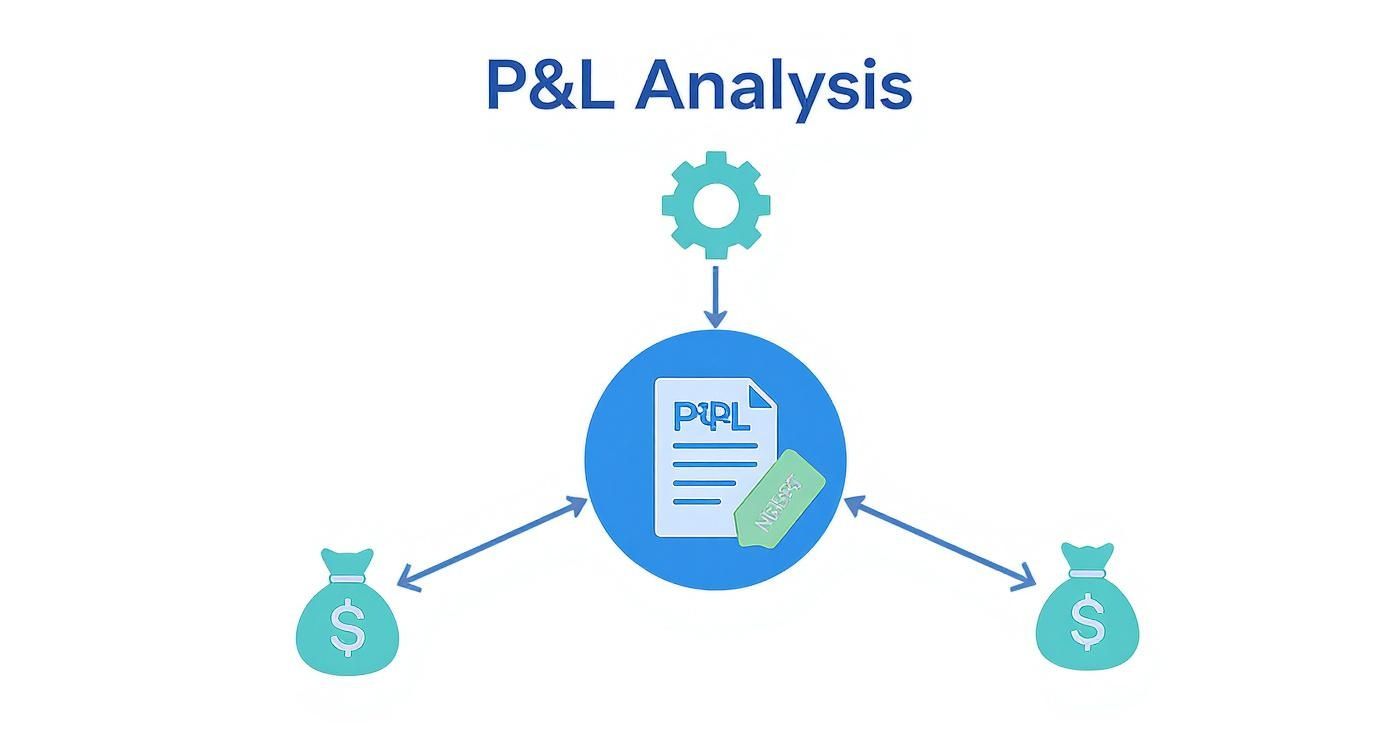
This connection is what shows how your day-to-day operations—all that selling and spending—directly build (or diminish) the long-term value of your business.
By looking at all three statements together, you get the complete story of your financial health. Focusing on just one gives you a dangerous blind spot. If you're looking for more ways to sharpen your financial oversight, check out these essential small business accounting tips.
Keeping Your P&L Honest: The Power of Smart Bookkeeping
A Profit and Loss statement is only as good as the numbers you feed it. Without clean, disciplined bookkeeping, your P&L is just a work of fiction—a dangerous one that can lead to some seriously bad business decisions and nasty financial surprises. This is where the theory of accounting hits the pavement of the real world.
Think about it: all the powerful insights we’ve talked about are completely useless if the underlying data is a mess. Even tiny, seemingly insignificant errors can snowball over time, totally distorting your financial picture. You might think you're having a killer quarter, only to find out it was a loser once the real numbers surface.
Sidestepping the Most Common Bookkeeping Traps
So, what trips most people up? It's usually the simple stuff. The good news is that with a little consistency and the right systems, these mistakes are entirely preventable.
Here are the top three errors that consistently wreck financial reports:
- Miscategorizing Expenses: This one is huge. For example, if you accidentally put a software subscription (an operating expense) into your Cost of Goods Sold, you'll artificially inflate your gross profit. This gives you a completely false sense of how efficiently you're producing your goods or services.
- Mixing Business and Personal Funds: Using your business card for a personal dinner or paying a business bill from your personal account creates an absolute nightmare. It becomes impossible to see the true cost of running your business and makes your accountant’s job a headache.
- Forgetting to Reconcile Accounts: If you're not regularly matching your books to your bank and credit card statements, your P&L is flying blind. You could be missing entire transactions or, worse, counting some twice. The report becomes totally unreliable.
A P&L statement is a direct reflection of your daily financial habits. Garbage in, garbage out isn’t just a saying; it’s a fundamental rule of accounting. An accurate report requires a commitment to clean data entry.
Building a System for Accuracy
Tools like QuickBooks Online are fantastic because they can automate a huge part of this process, pulling transactions directly from your bank feeds. But technology can't do it all. You still need a human brain to make sure every dollar ends up in the right bucket.
This is where non-negotiable practices like accounting reconciliation come in. It’s the simple (but crucial) process of verifying that the numbers in your accounting software line up perfectly with what your bank statements say. No ifs, ands, or buts.
A quick monthly review is your best defense against small issues turning into massive problems. Just run through a simple checklist:
- Reconcile all bank and credit card accounts.
- Scan your expenses—does every category look right?
- Confirm all your sales and income have been recorded.
This discipline is what keeps your financial data trustworthy and ready to inform your next big move. While it might be tempting to handle the books yourself to save a few bucks, many entrepreneurs find that the time lost and the high risk of error just aren't worth it. It’s often worth exploring the hidden costs of DIY bookkeeping to see if bringing in a pro makes more sense for your business.
Answering Your Lingering P&L Questions
Even after getting the hang of the basics, a few questions always seem to come up when you start putting your P&L to work. Let's tackle some of the most common ones to make sure you’re crystal clear on these concepts.
How Often Should I Really Be Looking at This Thing?
For just about every small business out there, a monthly review is the sweet spot. Think of it as your regular financial health check-up.
Looking at your P&L every month is frequent enough to catch problems while they're still small. You can spot a creeping expense, see if a new marketing push is actually working, and adjust your strategy on the fly. Waiting a full quarter, or even a year, is like only checking your rearview mirror every 20 miles—you’re bound to miss something important until it's too late. A consistent monthly rhythm keeps you in the driver's seat.
What's the Real Difference Between Gross and Net Profit?
This is a big one, and it gets right to the core of your business's health. It’s actually pretty simple when you break it down.
-
Gross Profit tells you how much money you make from your actual product or service, before any other business costs. It’s your revenue minus the direct costs of producing what you sold (your Cost of Goods Sold). It's a pure measure of your core offering's profitability.
-
Net Profit is the one everyone talks about: "the bottom line." This is what's left in the pot after every single expense has been paid—rent, staff salaries, software, marketing, you name it.
So, gross profit shows if your pricing and production are on point. Net profit tells you if the business as a whole is actually making money.
You can have an amazing gross profit but still end up with a terrible net profit if your overhead expenses are burning a hole in your pocket. You have to watch both.
How Can I Be “Profitable” But Still Have No Cash in the Bank?
Yes, and it happens more often than you'd think. This is probably the most critical reason you can't only look at your P&L. It's a classic cash flow trap.
Your P&L is usually built on accrual accounting, which means it records revenue the moment you earn it (like when you send an invoice), not when the cash actually lands in your account.
Imagine you close a huge $20,000 project. That revenue immediately shows up on your P&L, making the month look fantastic. But if the client has 60-day payment terms, you won't see that cash for two months. In the meantime, you’ve still got payroll, rent, and your own bills to pay. This is why you must always review your P&L with your Cash Flow Statement to get the full story on your financial situation.
A clear P&L statement is your roadmap to smart financial decisions. If you want to make sure your books are always accurate, organized, and ready to give you the insights you need, the team at Bugaboo Bookkeeping is here to help. Schedule a free consultation today and let's get your finances in order.